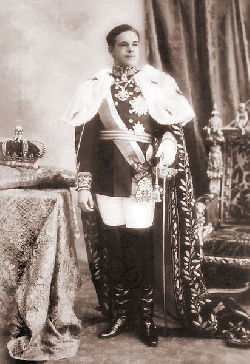
Manuel II of Portugal Part 2
Monarchs
- Life
- 15 November 1889 - 2 July 1932
- Birthday
- November 15
- Length
- 7 parts
As a youngster, Manuel played with the children of Count of Figueiró, the children of Count of Galveias and with the rest of the families of the Court in pleasant and cordial relations. In 1902, he was taught by Franz Kerausch (in literature Latin and German), later by Father João Damasceno Fiadeiro (in Portuguese history); Marquês Leitão (in Mathematics); M. Boeyé (in French and French literature); Alfredo King (in English and English literature), Father Domingos Fructuoso (in Religion and Morals) and Alexandre Rey Colaço (his piano teacher).
He travelled in 1903 with his mother, Queen Amélie of Orleans, and his brother to Egypt, on board the royal yacht Amélia, expanding his understanding of ancient civilizations. Later in 1907, he began his studies in order to enter the Portuguese Naval Academy, in preparation to follow a career in the Navy.
Death
He died unexpectedly in his residence on 2 July 1932 suffocated by an abnormal swelling in the vocal folds of his larynx, or tracheal oedema.Great Dynasties, 1980, p. 221 The Portuguese government, at that time led by António Oliveira de Salazar, authorized his burial in Lisbon, after a state funeral. His body arrived in Lisbon on 2 August 1932, on board the British cruiser HMS Concord which had made the journey from the United Kingdom and sailed into the Tagus River to deliver the coffin of the former King. The body was received at Praça do Comércio, where a crowd of people had gathered to follow the coffin to São Vicente de Fora and the roads were inundated with people interested in seeing the funeral procession. His body was interned in the Royal Pantheon of the House of Braganza in the Monastery of São Vicente de Fora.
By some he was given the nickname O Patriota (The Patriot), for his preoccupation with the national identity; O Desventurado (The Unfortunate), because he lost his throne to the Republic; and O Estudioso or O Bibliófilo (The Studious or The Bibliophile) for his love for Portuguese literature. Monarchists also referred to him as O Rei-Saudade (The Missed King), for the longing that was felt when the monarchy was abolished.
His death has been regarded as suspicious by some because of the fact that he had been playing tennis on 1 July and was apparently in excellent health. An incident surrounding his sudden death was mentioned in the autobiography of Harold Brust, a member of Scotland Yard Special Branch in charge of protecting public figures. In his memoirs, Brust speaks of an incident which probably occurred in 1931 in which an intruder was discovered in the grounds of Fulwell Park who, when arrested, the Police confirmed as being a prominent member of a Portuguese republican terrorist group known as the Carbonária and who was subsequently deported to Lisbon. To date the identity of the intruder has not been confirmed. Questions remain as to the reason for the man's intrusion.Luís Guerreiro, 2007–2010,
Since both the Dover and Paris Pacts did not resolve the issue of succession, there was no direct heir to the defunct throne. Manuel also made it clear that the branches of the Portuguese royal family (including the Imperial family of Brazil, the Braganza-Orleans, and the descendants of the Duke of Loulé) ended with the last direct male heir to the House of Braganza. Still, the monarchist Integralismo Lusitano movement acclaimed Duarte Nuno, Duke of Braganza as King of Portugal, since Miguel I of Portugal, on the death of his grandchild, was head of the Portuguese Royal Family. Their justification, ironically, included the fact that both branches had met to determine the line of succession in Dover and Paris, even though those accords were both later repudiated.
After his death, Oliveira Salazar founded, with the sale of his London estate for development and from the proceeds of his remaining personal possessions and those of the House of Braganza, the Foundation of the House of Braganza.
Paris Pact
In 1922, with cooling of relations between monarchists, Integralismo Lusitano and the King, and mindful that his marriage to Augusta Victória had not produced heirs, Manuel made overtures to Miguel's descendants. In a Paris meeting in April 1922, represented by his adjunct Aires de Ornelas, and Miguelist representatives Infanta Adelgundes, Duchess of Guimarães, and tutor to Duarte Nuno, they agreed that owing to an heir, the rights of succession would pass to Duarte Nuno. Constitutional monarchists were satisfied with the accord, but integralists were not: the agreement failed to make reference to the reestablishment of a traditional monarchy, which was fundamental to their assertions. Integralismo lusitano withheld their support, and on September 1925, Aldegundes in a letter to Manuel, repudiated the agreement owing the continue operation of the Constitutional Newspaper (the Integralist paper was closed as part of the accord) and the lack of Integralist participation. This ended the tentative reconciliation between the two branches of the House of Braganza.
Continue reading: part 3 of 7 →
