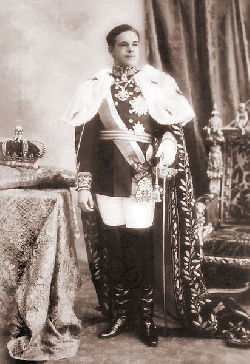
Manuel II of Portugal Part 3
Monarchs
- Life
- 15 November 1889 - 2 July 1932
- Birthday
- November 15
- Length
- 7 parts
Personal life
During a visit to Paris in July 1909, the King met Gaby Deslys, an actress and dancer, and immediately began a relationshipNobre, Eduardo, "Paixões Reais", Lisboa, Quimera Editores Lda., 2002. that would last until the end of Manuel II's reign. It was thought that after this first meeting the King sent Deslys a pearl necklace worth $70,000: more gifts soon followed, including a diamond necklace with black and white pearl drops set in a platinum band. Their relationship was anything but discreet (she would arrive before night at the Palácio das Necessidades and would pass through Portugal unnoticed); abroad, meanwhile, they were on the front pages of newspapers in Europe and North America, especially after he was deposed. In public interviews, usually on trips, Gaby Deslys never negated the obvious, but always refused to comment on her relationship with the King. After his exile, they would continue to meet, especially while she had stage engagements in London. When Gaby moved to New York, in the summer of 1911, their relationship broke off.
In the spring of 1912, Manuel visited Switzerland, where he met Augusta Victoria of Hohenzollern, Princess of Hohenzollern-Sigmaringen (1890–1966) and was deeply impressed by her. In the following year, on 4 September 1913, Manuel married Princess Augusta Victoria, his cousin (she was the granddaughter of the Infanta Antónia of Braganza) and daughter of Prince William, Prince of Hohenzollern. During the mass, which was celebrated in the Chapel of Sigmaringen Castle, Manuel, wearing his Order of the Garter medallion and the sash of the Three Portuguese Orders, stood on a crate containing soil brought from Portugal. The ceremony was presided by José Neto, Cardinal of Lisbon, then exiled in Seville, who had baptized Manuel when he was the Prince Royal; Manuel was also assisted by the Prince of Wales (Edward VIII) and King Afonso XIII of Spain, as well as representatives of the Royal Houses of Europe (including Spain, Germany, Italy, France and Romania, in addition to the principalities and German kingdoms). After festivities which lasted two days, the couple went on their honeymoon to Munich, where the Princess fell ill and withdrew from the public. The marriage, a calm and serene union, lasted until the death of the former King, but the couple did not have any children.
Lisbon regicide
His future career in the Navy was abruptly shelved on 1 February 1908. On that day, the royal family returned from the palace of Vila Viçosa to Lisbon, travelling by coach to Barreiro and from there took a boat across the Tagus River and disembarked in Cais do Sodré, in central Lisbon. On their way to the royal palace, the carriage carrying King Carlos and his family passed through the Terreiro do Paço. While the royal family was crossing the square, shots were fired from the crowd by at least two men: Alfredo Costa and Manuel Buiça. It was unclear whether the assassins were attempting to kill the King, the Prince Royal or the prime minister, João Franco, who had dissolved Parliament and was ruling as a dictator. The murderers were shot on the spot by members of the royal bodyguard and later recognized as members of the Portuguese Republican Party. The King was killed; his heir-apparent, Luís Filipe, Prince Royal of Portugal was mortally wounded; Infante Manuel was hit in the arm; Queen Amélie of Orleans was unharmed. It was Amélie's quick thinking that saved her youngest son. About twenty minutes later, Prince Luis Filipe died, and days later Manuel was acclaimed King of Portugal. The young King, who had not been groomed to rule, sought to save the fragile position of the Braganza dynasty by dismissing the dictator João Franco and his entire cabinet in 1908. The ambitions of the various political parties made Manuel's short reign a turbulent one. But, even so, in free elections held on 28 August 1910, the republicans only won 14 seats in the legislature.
Revolution
The stability of the government deteriorated; seven governments were established and fell in a period of 24 months. The monarchist parties continued to fragment, while the Republican Party continued to gain ground. The legislative elections on 28 August 1910 had elected 14 new representatives (resulting in an assembly that was divided: 9% Republican, 58% Government and 33% Opposition) which helped the revolutionary cause, but which made little importance since the Setubal Congress (on 24–25 April 1909) had determined that the Republicans would take power by force.Proença, Maria Cândida, 2006, "D. Manuel II" – Colecção "Reis de Portugal", Lisboa, Círculo de Leitores, p. 100 The murder of a prominent republican precipitated the coup d'etat that had been so long in coming.Hindley, Geoffrey. The Royal Families of Europe, p. 23.
Continue reading: part 4 of 7 →
