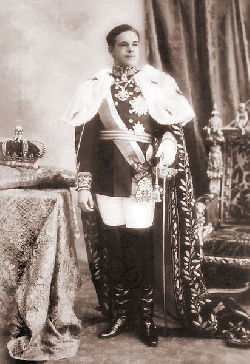
Manuel II of Portugal
Monarchs
- Life
- 15 November 1889 - 2 July 1932
- Birthday
- November 15
- Length
- 7 parts
Manuel II ( ; 15 November 1889 – 2 July 1932) was the last King of Portugal, "the Patriot" () or "the Unfortunate" (), ascending the throne after the assassination of his father, King Carlos I of Portugal, and his elder brother, Luís Filipe, Prince Royal of Portugal. Before ascending the throne he was Duke of Beja. His reign ended with the dissolution of the monarchy with the 5 October 1910 revolution, and Manuel lived the rest of his life in an exile enforced by the new Portuguese First Republic.
World War I
Being an Anglophile and admirer of the British spirit, Manuel defended the entry of Portugal into the First World War and its active participation. He asked monarchists to desist from restoration efforts as long as the war continued. He even met with republicans, and at one time, solicited his involvement in the Portuguese army. But, contrary to his hopes, a majority of the monarchists did not follow his pleas for cooperation. Many of them backed the aspirations of Germany, and had hoped to see the victory of the Kaiser as another channel to restore the monarchy. Manuel believed that supporting Great Britain would guarantee the retention of overseas colonies, which would have been lost to German aggression even if the Germans were supported in the conflict. Of his close subordinates who offered their support to the Republic, none was accepted.
Manuel attempted to make himself available to the Allies, wherever they saw use, but was disappointed when he was assigned a post in the British Red Cross. He characteristically put all his efforts into the role, participating in conferences, fund drives, visits to hospitals and the wounded soldiers on the front, which ultimately gave him a lot of gratification. The visits to the front were difficult on the French government, but his friendship with George V was sufficient enough to alleviate their concerns. Regardless, most of his efforts were not credited; years later, in an interview to António Ferro, he lamented, "The operating room in the Portuguese Hospital in Paris, during the War, was constructed by me. Do you know what they put on the plaque? 'From a Portuguese in London'."Ferro, António, “D. Manuel II, o Desventurado”, Lisboa, Livraria Bertrand, 1954, pp. 108–9. The King was also responsible for the creation of the Orthopedic Department at Shepards Bush Hospital which, at his insistence continued to function until 1925, in order to continue to treat the disfiguring affects of the war. A proof of his recognition by the British was by his friend George V, who invited him to be with the King during the victory celebrations during the parade of soldiers in 1919.
Early life
Infante D. Manuel, Duke of Beja, c. 1901, around age 12. Manuel Maria Filipe Carlos Amélio Luís Miguel Rafael Gabriel Gonzaga Francisco de Assis Eugénio de Bragança was born in the last year of the reign of his grandfather, King Luís I; he was the third child,The second child was a girl, Maria Ana, who died shortly after her birth. and last son, born to Carlos I of Portugal and Amélie of Orleans in the Palace of Belém, Lisbon, seven months before his father ascended the Portuguese throne. He was baptizedThe newborn Infante was named after his paternal great-grandfather, Victor Emmanuel II; his grandmother, Maria Pia, thought it would be a kind homage to the unifier of Italy. a few days later, with his maternal grandfather as godfather. The former Emperor Pedro II of Brazil, who had been deposed from the Brazilian throne on the day of Manuel's birth, attended the ceremony.
He received the traditional education bestowed on a member of the royal family, without the political preoccupations that befell his older brother, who was destined by birth to become King. Although Manuel was raised as member of the upper classes, he took a more public tone after ascending to the throne, and abandoned many of the customary protocols of the court.In the annual Beija-mão Real ("Kiss the Royal Hand") ceremony, on January 1, he declined to participate in the tradition requiring dignitaries to kiss the King's hand; (Eduardo Nobre, 2002) He studied history and languages, and at the age of six already spoke and wrote in French. He studied music under pianist Alexandre Rey Colaço). From the beginning he demonstrated an inclination to literature and reading, which contrasted with his older brother, who was more interested in physical activities. In the style imposed by his great-grandparents (Queen Maria II and King Fernando II), Manuel's upbringing included horse riding, fencing, rowing, tennis and gardening. He was a great admirer of music, listened to Beethoven and Wagner, and played the piano.
Continue reading: part 2 of 7 →
