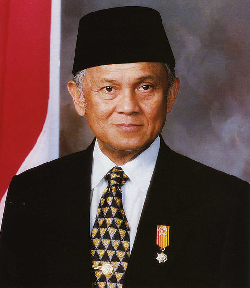
B. J. Habibie Part 4
Presidents
- Life
- 25 June 1936
- Birthday
- June 25
- Length
- 4 parts
Political Reform
Under Habibie, Indonesia made significant changes to its political system that expanded competition and freedom of speech. Shortly after taking office, in June 1998, Habibie's government lifted the Suharto-era restriction on political parties and ended censorship by dissolving the Information Ministry. He also quickly committed to holding democratic elections, albeit on an initially vague timetable. In December, he proposed political reform laws that were passed by the legislature and MPR session. These laws set elections for December 1999, reduced the number of seats in parliament held by the military, and barred political activity by civil servants.
However, political opponents criticized Habibie for agreeing to give the military some seats in parliament, and taking little action on other military and judicial reforms. The military retained its territorial command system and practice of seconding officers to civil-service posts, and there were few prosecutions for Suharto-era corruption under Habibie.
End of presidency
Although he had been viewed as leading a transitional government, Habibie seemed determined to continue as president. Habibie was initially unclear about whether he would seek a full term as president when he announced parliamentary elections in June 1998. Habibie faced opposition from many within the government party, Golkar; in July 1998, he struggled to win control of the party by appointing Akbar Tandjung as chair of the party, but was ultimately able to defeat a rival camp including former Vice President Try Sutrisno, Defence Minister Edi Sudrajat, Siswono, and Sarwono.
However, at the same time, Habibie began to lose support from Akbar Tandlung and a faction in Golkar, composed of both reformers and hardliners, that wanted to oust him. In March 1999, Golkar put forth five presidential nominees: Habibie, Tandjung, Wiranto, Hamungbukuwono X, and Ginandjar. In May 1999, Golkar announced that Habibie would be their presidential candidate after extensive lobbying, but a large faction in the party remained loyal to Tandjung and opposed to Habibie.
Post-presidency
Since relinquishing the presidency, he has spent more time in Germany than in Indonesia, though he has during Susilo Bambang Yudoyono's presidency been active both as a presidential adviser and through the Habibie Centre to ensure democratisation in Indonesia.
In September 2006, he released a book called Detik-Detik Yang Menentukan: Jalan Panjang Indonesia Menuju Demokrasi (Decisive Moments: Indonesia's Long Road Towards Democracy). The book recalled the events of May 1998 which led to his rise to the Presidency. In the book, he controversially accuses Lieutenant General Prabowo Subianto, Suharto's son-in-law (at that time) and the Kostrad Commander, of planning a coup d'état against him in May 1998.


