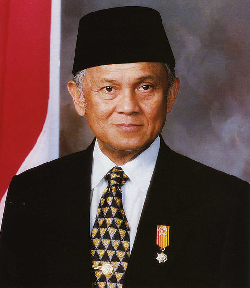
B. J. Habibie Part 2
Presidents
- Life
- 25 June 1936
- Birthday
- June 25
- Length
- 4 parts
When Habibie's minimum wage salary forced him into part-time work, he found employment with the automotive marque Talbot, where he became an adviser. Habibie worked on two projects which received funding from Deutsche Bundesbahn.
Due to his work with Makosh, the head of train constructions offered his position to Habibie upon retirement three years later, but Habibie refused.
In 1965, Habibie delivered his thesis in aerospace engineering and received the grade of "very good" for his dissertation, giving him the title Doktor der Ingenieurwissenschaften. During the same year, he accepted Hans Ebner's offer to continue his research on Thermoelastisitas and work toward his Habilitation, but he declined the offer to join RWTH as a professor per se. His thesis about light construction for supersonic or hypersonic states also attracted offers of employment from companies such as Boeing and Airbus, which Habibie again declined.
Habibie did accept a position with Messerschmitt-Bölkow-Blohm in Hamburg. There, he developed theories on thermodynamics, construction, and aerodynamics known as the Habibie Factor, Habibie Theorem, and Habibie Method, respectively.. He worked for Messerschmidt on the development of the Airbus A-300B aircraft. In 1974, he was promoted to vice president of the company.
Habibie's time in Europe may have contributed to his interest in Leica cameras.
Presidency
Rise to office
By May 1998, problems including poverty had caused such discontent that Suharto's government fell into crisis. On 13 May, the shooting of four students at Trisakti University in Jakarta, caused extreme anger, which in turn led to widespread riots and lootings. There were now explicit calls for Suharto to step down as president of Indonesia.
Suharto responded by saying on 19 May 1998 that if he stepped down, the vice president would become president, and in a not too subtle jab at Habibie he added he was not sure whether the vice president could solve the problems facing the country.
After learning of Suharto's comments from television reports, Habibie discounted his mentor and became increasingly sympathetic to those who wanted Suharto to step down. While careful not to oppose him directly or support those who did, he left the president in little doubt that he saw himself as Suharto's legitimate successor.
Suharto, faced with dwindling civilian and military support, even among loyalists like Wiranto and Ginandjar Kartasasmita, resigned late on the evening of 20 May 1998.
The next morning, on 21 May 1998, Suharto publicly announced his resignation and Habibie was immediately sworn in as president. There were mixed reactions to Habibie's elevation to the presidency. Hard-line reformists saw him as an extension of Suharto's regime while moderate reformists saw him as leading a transitional government.
With the release of Habibie's 2006 book, Detik-Detik Yang Menentukan: Jalan Panjang Indonesia Menuju Demokrasi (Decisive Moments: Indonesia's Long Road Towards Democracy), there is speculation that Suharto had wanted Habibie to resign along with him.
In Javanese style, Suharto had subtly hinted at this intention. Habibie, despite being of Javanese descent, neither took the hint nor acquiesced. Because his intentions had been ignored, Suharto showed nothing but contempt for Habibie and never spoke to his former colleague again.
Cabinet
Habibie's cabinet, which was called the Development Reform Cabinet, employed many of those present in Suharto's last cabinet.Miller, Michelle Ann. Rebellion and Reform in Indonesia (London: Routledge 2008), pp.14–18 ISBN 978-0-415-45467-4 However, to show his reformist intentions, Habibie included the United Development Party (PPP) member Hamzah Haz.
East Timor
Habibie opposed East Timorese Independence but did consider giving East Timor special autonomy.Miller, M. (2004). 'From reform to repression: the post-New Order's shifting security policies in Aceh', Review of Indonesian and Malaysian Affairs, 38(4), 129–162.
Continue reading: part 3 of 4 →


