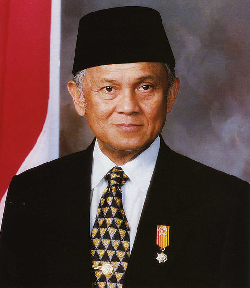
B. J. Habibie
Presidents
- Life
- 25 June 1936
- Birthday
- June 25
- Length
- 4 parts
Bacharuddin Jusuf Habibie (born 25 June 1936) is a former politician of the State of Indonesia. His presidency (1998–1999) was the third, and the shortest, after independence.
Early life
Habibie was born in Parepare, South Sulawesi Province to Alwi Abdul Jalil Habibie and R. A. Tuti Marini Puspowardojo. His father was an agriculturist from Gorontalo of Bugis descent and his mother was a Javanese noblewoman from Yogyakarta. His parents met while studying in Bogor. When he was 14 years old, Habibie's father died.
Family
Habibie & AinunNotes
Member of Golkar
In Suharto's regime, as was expected of senior government executives, Habibie became a member of the Golkar organisation. From 1993–1999, he was a daily coordinator for the chairman of the executive board.
Career in Indonesia
In 1974, Suharto recruited Habibie to return to Indonesia as part of Suharto's drive to industrialize and develop the country. Habibie initially served as a secial assistant to Ibnu Sutowo, the CEO of state oil company Pertamina. Two years later, in 1976, Habibie was made Chief Executive Officer of the new state-owned enterprise Industri Pesawat Terbang Nusantara (IPTN). (In 1985, PT. Nurtanio changed its name to Indonesian Aviation Industry and is now known as Indonesian Aerospace Inc. (Dirgantara)). In 1978, he was appointed as Minister of Resesarch and Technology. He continued to play an important role in IPTN other "strategic" industries in this post. By the 1980s, IPTN had grown considerably, specializing in the manufacture of helicopters and small passenger planes; by 1991, Habibie oversaw ten state-owned industries including ship- and train-building, steel, arms, communications, and energy. A 1993 estimate determined that the estimates used nearly $2 billion a year in state funding, although the government's opaque accounting practices meant that the size of the industries was not completely known.
Habibie became a pilot, assisted in his training by A.B. Wolff, former chief of staff of the Dutch Air Force. In 1995, he flew an N-250 (dubbed Gatotkoco) commuter plane.
In developing Indonesia's aviation industry, he adopted an approach called "Begin at the End and End at the Beginning". In this method, elements such as basic research became the last things upon which to focus, whilst actual manufacturing of the planes was placed as the first objective. Under Habibie's leadership, IPTN became a manufacturer of aircraft including Puma helicopters and Cassa planes. It pioneered a small passenger airplane, the N-250 Gatokaca, in 1995, but the project was a commercial failure.
Vice presidency
In January 1998, after accepting nomination for a 7th term as President, Suharto announced the selection criteria for the nomination of a vice president. Suharto did not mention Habibie by name, but his suggestion that the next vice president should have a mastery of science and technology made it obvious he had Habibie in mind.
In that year, in the midst of the Asian Financial Crisis, this suggestion was received badly, causing the rupiah to fall. Despite this and protests (the former minister Emil Salim tried to nominate himself as vice president), Habibie was elected vice president in March 1998.
Studies and career in Germany
Following his father's death, Habibie continued his studies in Jakarta and then in 1955 moved to Germany.
In 1960, Habibie received a degree in engineering in Germany, giving him the title Diplom-Ingenieur. He remained in Germany as a research assistant under Hans Ebner at the Lehrstuhl und Institut für Leichtbau, RWTH Aachen to conduct research for his doctoral degree.
In 1962, Habibie returned to Indonesia for three months on sick leave. During this time, he was reacquainted with Hasri Ainun, the daughter of R. Mohamad Besari. Habibie had known Hasri Ainun in childhood, junior high school and in senior high school at SMA-Kristen, Bandung. The two married on 12 May 1962, returning to Germany shortly afterwards. Habibie and his wife settled in Aachen for a short period before moving to Oberforstbach. In May 1963 they had a son, Ilham Akbar Habibie.
Continue reading: part 2 of 4 →


