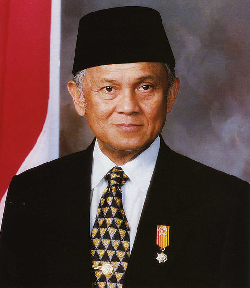
B. J. Habibie Part 3
Presidents
- Life
- 25 June 1936
- Birthday
- June 25
- Length
- 4 parts
In late 1998, John Howard, then Prime Minister of Australia advised Indonesia of a change in Australian foreign policy, to whit Australia would advocate a referendum in East Timor on independence within a decade. Other international pressure also mounted on Indonesia to allow self-determination for the province. Wishing to avoid the impression that Indonesia ruled East Timor as a colony, Habibie surprised some by announcing that a referendum, offering a choice between special autonomy and independence, would be held in East Timor. ABRI opposed this decision.
On 30 August 1999, the referendum was held and the East Timorese people overwhelmingly chose Independence in mostly free and fair elections. However, the retreat of Indonesian troops from East Timor created the 1999 East Timorese crisis where many were killed. Although Habibie favored the quick deployment of a UN peacekeeping force to halt violence, the military opposed this plan. On September 10, General Wiranto allegedly threatened to stage a military coup if Habibie allowed in peacekeeping forces, causing Habibie to back down. Habibie also publicly ordered security personnel to stop violence in the territory, but his orders went largely unheeded.
Suharto's corruption charge
The MPR Special Session in November 1998 declared that an investigation should be made into corruption in Indonesia, focussing particularly on Suharto.
Habibie formed a special commission on corruption which, to the Reformasi, represented a gesture of good faith. The noted lawyer Adnan Buyung Nasution was invited to chair the investigation. The broad scope of the terms of reference Nasution suggested was unacceptable to Habibie, who then appointed Attorney General and loyalist, Andi Muhammad Ghalib.
On 9 December 1998, Suharto was questioned for three hours by Ghalib. The Habibie government declared that Suharto had gained his wealth through corruption.
A tape of a telephone conversation between Habibie and Ghalib was made public. It raised concerns about the veracity of the investigation by suggesting that the interrogation of Suharto was intended only for public appearances.
Under Habibie, the Indonesian government also began investigating and prosecuting Suharto's youngest son, Tommy Suharto. Tommy Suharto was charged by Ghalib in December 1998 in conjunction with the Goro scandal, where the government, under pressure from Tommy Suharto, allegedly gave him a desirable parcel and below-market loan for the construction of a Goro supermarket. However, Tommy Suharto was found innocent in the case after several key witnesses, including one of Habibie's aides - Rahardi Ramelan - changed their testimony and declared that the deal did not cause losses to the state.
The economy
Habibie's government stabilized the economy in the face of the Asian financial crisis and the chaos of the last few months of Suharto's presidency.
Social issues
Habibie's government began to make concilliatory gestures towards Chinese Indonesians who, because of their elite status, were targeted in the riots of 1998. In September 1998, Habibie issued a 'Presidential Instruction' forbidding use of the terms pribumi and non-pribumi to differentiate indigenous and non-indigenous Indonesians.
In May 1999, Habibie issued a further instruction directing that a display of an ID card would suffice as proof of Indonesian citenzenship, whereas previously, displaying a 'Letter of Evidence of Republic of Indonesia Citizenship' (SBKRI) was required. Although the Chinese Indonesian community was not mentioned specifically, it is clear these policies were targeted towards Chinese Indonesians who, in the Suharto years, were referred to as non-Pribumi and had to display the SBKRI to prove their Indonesian citizenship.
Education
When Habibie was State Minister for Research and Technology, he created the OFP (Overseas Fellowship Program), SMDP (Science and Manpower Development Program) and STAID (Science and Technology for Industrial Development). These three programs were to provide scholarships to thousands of students to continue their study for master’s and doctorate program in the United States, Europe, Japan, and other countries.
Continue reading: part 4 of 4 →


