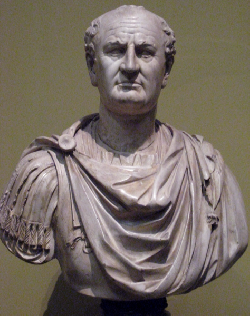
Vespasian Part 6
Roman Emperor
- Life
- 17 November AD 9 - 23 June AD 79
- Length
- 6 parts
Vespasian was indeed noted for mildness when dealing with political opposition. According to Suetonius, he bore the frank language of his friends, the quips of pleaders, and the impudence of the philosophers with the greatest patience. Though Licinius Mucianus, a man of disputable reputation as being the receiver in homosexual sex, treated the Emperor with scant respect, Vespasian never criticised him publicly but privately uttered the words: "I, at least, am a man. "Suetonius, The Lives of Twelve Caesars, Life of Vespasian 13 He was also noted for his benefactions to the people. Much money was spent on public works and the restoration and beautification of Rome: a new forum, the Temple of Peace, the public baths and the great show piece, the Colosseum.
Vespasian debased the denarius during his reign, reducing the silver purity from 93.5% to 90% — the silver weight dropping from 2.97 grams to 2.87 grams.
In modern Romance languages, urinals are still named after him (for example, vespasiano in Italian, and vespasienne in FrenchFor example, in E. E. Cummings' autobiographical novel The Enormous Room.) probably in reference to a tax he placed on urine collection (useful due to its ammoniac content; see Pay toilet).
Vespasian appears as the king of Paltisca in Saxo Grammaticus' Gesta Danorum, 2.1.7.
Family
Vespasian was born in a village north-east of Rome called Falacrinae.Suetonius, The Lives of Twelve Caesars, Life of Vespasian 2 His family was relatively undistinguished and lacking in pedigree. His paternal grandfather, Titus Flavius Petro, became the first to distinguish himself, rising to the rank of centurion and fighting at Pharsalus for Pompey in 48 BC. Subsequently he became a debt collector.
Petro's son, Titus Flavius Sabinus, worked as a customs official in the province of Asia and became a money-lender on a small scale among the Helvetii. He gained a reputation as a scrupulous and honest "tax-farmer". Sabinus married up in status, to Vespasia Polla, whose father had risen to the rank of prefect of the camp and whose brother became a Senator.
Sabinus and Vespasia had three children, the eldest of whom, a girl, died in infancy. The elder boy, Titus Flavius Sabinus entered public life and pursued the cursus honorum. He served in the army as a military tribune in Thrace in 36. The following year he was elected quaestor and served in Crete and Cyrene. He rose through the ranks of Roman public office, being elected aedile on his second attempt in 39 and praetor on his first attempt in 40, taking the opportunity to ingratiate himself with the Emperor Caligula.
The younger boy, Vespasian, seemed far less likely to be successful, initially not wishing to pursue high public office. He followed in his brother's footsteps when driven to it by his mother's taunting. During this period he married Flavia Domitilla, the daughter of Flavius Liberalis from Ferentium and formerly the mistress of Statilius Capella, a Roman equestrian from Sabrata in Africa.Suetonius, The Lives of Twelve Caesars, Life of Vespasian 3
They had two sons, Titus Flavius Vespasianus (born 41) and Titus Flavius Domitianus (born 51), and a daughter, Domitilla (born 39). His wife Domitilla and his daughter Domitilla both died before Vespasian became Emperor in 69. After the death of his wife, Vespasian's longstanding mistress, Antonia Caenis, became his wife in all but formal status, a relationship that survived until she died in 75.