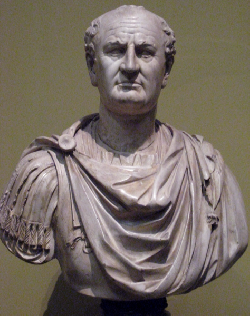
Vespasian
Roman Emperor
- Life
- 17 November AD 9 - 23 June AD 79
- Length
- 6 parts
Vespasian ( or ;In Classical Latin, Vespasian's name would be inscribed as TITVS FLAVIVS CAESAR VESPASIANVS AVGVSTVS. 17 November 9 – 23 June 79)Levick, Vespasian, 4.Levick, Vespasian, xxi. was Roman Emperor from AD 69 to AD 79. Vespasian was the founder of the Flavian dynasty, which ruled the Empire for a quarter century. Vespasian was descended from a family of equestrians, who rose into the senatorial rank under the Emperors of the Julio-Claudian dynasty. Although he attained the standard succession of public offices, holding the consulship in AD 51, Vespasian became more reputed as a successful military commander, participating in the Roman invasion of Britain in 43,Levick, Vespasian, 16. and subjugating Judaea during the Jewish rebellion of AD 66.Levick, Vespasian, 29–38.
While Vespasian was preparing to besiege the city of Jerusalem during the latter campaign, emperor Nero committed suicide, plunging the empire into a year of civil war known as the Year of the Four Emperors. After the emperors Galba and Otho perished in quick succession, Vitellius became Emperor in April AD 69. In response, the armies in Egypt and Judaea declared Vespasian emperor on 1 July.Levick, Vespasian, 43.
In his bid for imperial power, Vespasian joined forces with Mucianus, the governor of Syria, and Primus, a general in Pannonia. Primus and Mucianus led the Flavian forces against Vitellius, while Vespasian gained control of Egypt. On 20 December, Vitellius was defeated, and the following day Vespasian was declared Emperor by the Roman Senate.
Little information survives about the government during the ten years Vespasian was emperor. His reign is best known for financial reforms following the demise of the Julio-Claudian dynasty, the successful campaign against Judaea, and several ambitious construction projects, such as the Colosseum. Upon his death in 79, he was succeeded by his eldest son Titus, thus becoming the first Roman Emperor to be directly succeeded by his own son.
Emperor (69-79)
Aftermath of the civil war
A bust of Vespasian, [[Pushkin Museum, Moscow.]] Vespasian was declared emperor by the Senate while he was in Egypt in December of 69 (the Egyptians had declared him emperor in June 69). In the short-term, administration of the empire was given to Mucianus who was aided by Vespasian's son, Domitian. Mucianus started off Vespasian's rule with tax reform that was to restore the empire's finances. After Vespasian arrived in Rome in mid-70, Mucianus continued to press Vespasian to collect as many taxes as possible.Cassius Dio, Roman History, LXVI.2
Vespasian and Mucianus renewed old taxes and instituted new ones, increased the tribute of the provinces, and kept a watchful eye upon the treasury officials. The Latin proverb "Pecunia non olet" ("Money does not smell") may have been created when he had introduced a urine tax on public toilets.
In early 70, Vespasian was still in Egypt, the source of Rome's grain supply, and had not yet left for Rome. According to Tacitus, his trip was delayed due to bad weather.Tacitus, Histories IV Modern historians theorize that Vespasian had been and was continuing to consolidate support from the Egyptians before departing.Sullivan, Phillip, "A Note on Flavian Accession", The Classical Journal, 1953, p. 67-70 Stories of a divine Vespasian healing people circulated in Egypt.Cassius Dio, Roman History LXVI.2 During this period, protests erupted in Alexandria over his new tax policies and grain shipments were held up. Vespasian eventually restored order and grain shipments to Rome resumed.
In addition to the uprising in Egypt, unrest and civil war continued in the rest of the empire in 70. In Judea, rebellion had continued from 66. Vespasian's son, Titus, finally subdued the rebellion with the capture of Jerusalem and destruction of the Jewish Temple in 70. According to Eusebius, Vespasian then ordered all descendants of the royal line of David to be hunted down, causing the Jews to be persecuted from province to province. Several modern historians have suggested that Vespasian, already having been told by Josephus that he was prophesied to become emperor whilst in Judaea, was probably reacting to other widely known Messianic prophecies circulating at the time, to suppress any rival claimants arising from that dynasty.e.g., Paul Barnett, Jesus & the Rise of Early Christianity p. 31; 1911 Encyclopædia Britannica, "JEWS".
Continue reading: part 2 of 6 →