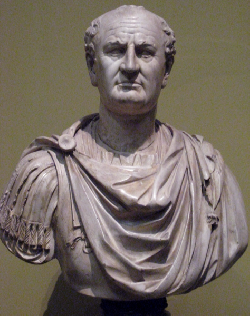
Vespasian Part 3
Roman Emperor
- Life
- 17 November AD 9 - 23 June AD 79
- Length
- 6 parts
Suetonius claims that Vespasian was met with "constant conspiracies" against him.Suetonius, The Lives of Twelve Caesars, Life of Vespasian 25 Only one conspiracy is known specifically, though. In 78 or 79, Eprius Marcellus and Aulus Caecina Alienus attempted to kill Vespasian. Why these men turned against Vespasian is not known.
Roman expansion in Britain
In 78, Agricola was sent to Britain, and both extended and consolidated the Roman dominion in that province, pushing his way into what is now Scotland.
Death (79)
In his ninth consulship Vespasian had a slight illness in Campania and, returning at once to Rome, he left for Aquae Cutiliae and the country around Reate, where he spent every summer; however, his illness worsened and he developed severe diarrhea.
On 23 June 79, Vespasian was on his deathbed and expiring rapidly, he demanded that he be helped to stand as he believed "An emperor should die on his feet". He died of a fever. His purported great wit can be glimpsed from his last words; Væ, puto deus fio, "Oh! I think I'm becoming a god!".Cassius Dio Roman History
Year of the Four Emperors (69)
After the death of Nero in 68, Rome saw a succession of short-lived emperors and a year of civil wars. Galba was murdered by Otho, who was defeated by Vitellius. Otho's supporters, looking for another candidate to support, settled on Vespasian.
According to Suetonius, a prophecy ubiquitous in the Eastern provinces claimed that from Judaea would come the future rulers of the world. Vespasian eventually believed that this prophecy applied to him, and found a number of omens, oracles, and portents that reinforced this belief.Cassius Dio Roman History
A map of the Roman Empire during the [[Year of the Four Emperors (69). Blue areas indicate provinces loyal to Vespasian and Gaius Licinius Mucianus. ]] He also found encouragement in Mucianus, the governor of Syria; and, although Vespasian was a strict disciplinarian and reformer of abuses, Vespasian's soldiers were thoroughly devoted to him. All eyes in the East were now upon him. Mucianus and the Syrian legions were eager to support him. While he was at Caesarea, he was proclaimed emperor (1 July 69), first by the army in Egypt under Tiberius Julius Alexander, and then by his troops in Judaea (11 July according to Suetonius, 3 July according to Tacitus).
Nevertheless, Vitellius, the occupant of the throne, had Rome's best troops on his side — the veteran legions of Gaul and the Rhineland. But the feeling in Vespasian's favour quickly gathered strength, and the armies of Moesia, Pannonia, and Illyricum soon declared for him, and made him the de facto master of half of the Roman world.
While Vespasian himself was in Egypt securing its grain supply, his troops entered Italy from the northeast under the leadership of M. Antonius Primus. They defeated Vitellius's army (which had awaited him in Mevania) at Bedriacum (or Betriacum), sacked Cremona and advanced on Rome. They entered Rome after furious fighting. In the resulting confusion, the Capitol was destroyed by fire and Vespasian's brother Sabinus was killed by a mob.
On receiving the tidings of his rival's defeat and death at Alexandria, the new emperor at once forwarded supplies of urgently needed grain to Rome, along with an edict or a declaration of policy, in which he gave assurance of an entire reversal of the laws of Nero, especially those relating to treason. While in Egypt he visited the Temple of Serapis, where reportedly he experienced a vision. Later he was confronted by two labourers who were convinced that he possessed a divine power that could work miracles.
Military and political career
Early career
In preparation for a praetorship, Vespasian needed two periods of service in the minor magistracies, one military and the other public. Vespasian served in the military in Thrace for about 3 years. On his return to Rome in about 30 AD, he obtained a post in the vigintivirate, the minor magistracies, most probably in one of the posts in charge of street cleaning. His early performance was so unsuccessful that Emperor Caligula reportedly stuffed handfuls of muck down his toga to correct the uncleaned Roman streets, formally his responsibility.
Continue reading: part 4 of 6 →