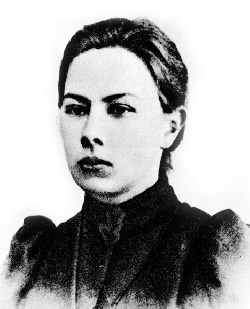
Krupskaya directed a census of the libraries in order to address these issues.N. K. Krupskaya, Part two : Krupskaia on libraries, ed Sylva Simsova (Hamden : Archon Books, 1968) 45–51. She encouraged libraries to collaborate and to open their doors to the general public. She encouraged librarians to use common speech when speaking with patrons. Knowing the workers needs was encouraged; what kind of books should be stocked, the subjects readers were interested in, and organizing the material in a fashion to better serve the readers. Committees were held to improve card catalogs.
Krupskaya stated at a library conference: “We have a laughable number of libraries, and their book stocks are even more inadequate. Their quality is terrible, the majority of the population does not know how to use them and does not even know what a library is.”Raymond, 161.
She also sought better professional schools for librarians. Formal training was scarce in pre-revolutionary Russia for librarians and it only truly began in the 20th century. Krupskaya, therefore, advocated the creation of library “seminaries” where practicing librarians would instruct aspiring librarians in the skills of their profession, similar to those in the West. The pedagogical characteristics were however those of the Soviet revolutionary period. Librarians were trained to determine what materials were suitable to patrons and whether or not they had the ability to appreciate what the resource had to offer. Also, Krupskaya desired that librarians possess greater verbal and writing skills so that they could more clearly explain why certain reading materials were better than others to their patrons. She believed that explaining resource choices to patrons was a courtesy and an opportunity for more education in socialist political values, not something that was required of the librarian. They were to become facilitators of the revolution and, later, those who helped preserve the values of the resulting socialist state.
Krupskaya was a committed Marxist for whom each element of public education was a step toward improving the life of her people, granting all individuals access to the tools of education and libraries, needed to forge a more fulfilling life. The fulfillment was education and the tools were education and library systems.Raymond, 172.
Married life
It was at a similar discussion circle that Krupskaya first met Vladimir Ilyich Ulyanov, a dedicated Marxist who later came to be called Lenin. Krupskaya was impressed by his speeches but not his personality, at least at first. It is hard to know very much of the courtship between Lenin and Krupskaya as neither party spoke often of personal matters.
In October 1896, several months after Lenin was arrested, Krupskaya was also arrested. After some time, Lenin was sentenced to exile in Siberia. They had very little communication while in prison but before leaving for Siberia, Lenin wrote a "secret note" to Krupskaya that was delivered by her mother. It suggested that she could be permitted to join him in Siberia if she told people she was his fiancée. At that time, Krupskaya was still awaiting sentencing in Siberia. Krupskaya was permitted to accompany Lenin but only if they were married as soon as she arrived.
In her memoirs, Krupskaya notes "with him even such a job as translation was a labour of love".http://www.marxists.org/archive/krupskaya/works/rol/rol01.htm Her relationship with Lenin was more professional than marital, which Kollontai compared to slavery, but she remained loyal, never once considering divorce.
Krupskaya is believed to have suffered from Graves’ disease,H. Rappaport, Conspirator (London: Hutchinson, 2009), 200. an illness affecting the thyroid gland in the neck which causes the eyes to bulge and the neck to tighten. In female sufferers, it can also disrupt the menstrual cycle, which may explain why Lenin and Krupskaya never had children (and the rumors about Lenin having an affair with Inessa Armand).
Upon his release, Lenin went off to Europe and settled in Munich where Krupskaya later met up with him upon her release (1901). After she had arrived the couple moved to London.
Sources
- Raymond, Boris The contribution of N. K. Krupskaia to the development of Soviet Russian Librarianship: 1917–1939 (Ann Arbor : The University of Chicago, 1978)
Legacy
Following her death in 1939 a Leningrad chocolate factory was renamed in her honour. Its chocolate bar product was named Krupskaya and retains that name today.
The asteroid 2071 Nadezhda discovered in 1971 by Soviet astronomer Tamara Mikhailovna Smirnova was named in her honour.
Gallery
File:Крупская и Николаева.jpg|Krupsakaya (right) in 1936 File:Krupskaja-old.jpg|Krupskaya (middle) in the 1930s File:Krupskaja Spandau.jpg|Board at a kindergarten in Berlin-Spandau, Germany

