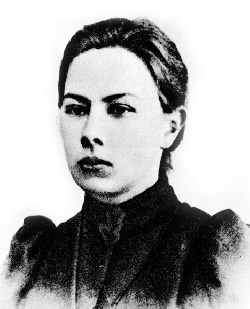
Nadezhda Konstantinovna "Nadya" Krupskaya ( scientific transliteration Nadežda Konstantinovna Krupskaja) (14 February (26 February) 1869 – February 27, 1939)McNeal, 13. was a Bolshevik revolutionary and politician. She married the Russian revolutionary leader Vladimir Lenin in 1898. She was deputy minister (Comissar) of Education in 1929–1939, Doctor of Education.
Political career
Krupskaya’s political life was active: she was a functionary of the Bolshevik faction of the Russian Social Democratic Labour Party from 1903. She became secretary of the Central Committee in 1905; she returned to Russia the same year, but left again after the failed revolution of 1905 and worked as a teacher in France a couple of years.
After the October Revolution in 1917, she was appointed deputy to Anatoliy Lunacharskiy, the People’s Commissar for Education, where she took charge of Vneshkol’nyi Otdel the Adult Education Division; she became chair of the education committee in 1920 and was deputy commissar (government minister) from 1929 to 1939. She was instrumental in the foundation of Komsomol and the Pioneer movement as well as the Soviet educational system, including the censorship and political indoctrination within it. She was also fundamental in the development of Soviet librarianship.
Krupskaya became a member of the Central Committee of the Communist Party of the Soviet Union in 1924, a member of its control commission in 1927, a member of the Supreme Soviet in 1931 and an honorary citizen in 1931. She apparently favored Stalin in the great debates between the Left Opposition and the CPSU majority of the 1920s. In 1925, she attacked Lev Trotsky in a polemic that was in response to Trotsky’s tract The Lessons of October. In it, she stated that "Marxist analysis was never Comrade Trotsky’s strong point." In relation to the debate around Socialism in one country versus Permanent Revolution, she asserted that Trotsky "under-estimates the role played by the peasantry." Furthermore, she held that Trotsky had misinterpreted the revolutionary situation in post-World War I Germany. During the congress of 1925, she initially supported Grigory Zinoviev and Lev Kamenev, but eventually voted for the process against Nikolai Bukharin and the exclusion of Trotsky, Zinoviev and Kamenev from the party. Source: The Errors of Trotskyism, Communist Party of Great Britain, May 1925
In 1936 she defended restrictions on abortion passed by the Soviet government in that year, arguing that they were part of a consistent policy pursued since 1920 to do away with the reasons to have an abortion.
In old age Krupskaya wrote a memoir of her life with Lenin, translated in 1930 as Memories of Lenin and in 1970 as Reminiscences of Lenin,., International Publishers, 1970 The book gives the most detailed account of Lenin’s life before his coming to power and ends in 1919. However, the text was edited by other hands after Krupskaya finished it and so may not be entirely reliable.
Early life
She was born to an upper-class, but impoverished, family. Her father was a Russian military officer, a nobleman of the Russian Empire. Nadya’s father, Konstantin Ignat’evich Krupski, was orphaned in 1847 at nine years of age. He was educated and given a commission as an infantry officer in the Russian Army. Just before leaving for his assignment in Poland he married Nadya’s mother. After six years of service, Krupski lost favor with his supervisors and was charged with “un-Russian activities.” He may have been suspected of being involved with revolutionaries. Following this time, he worked in factories or wherever he could find work until later in life when he was recommissioned just before his death.McNeal, 5–9.
Her mother, Elizaveta Vasilyevna Tistrova, was the daughter of landless Russian nobles. Elizaveta’s parents died when she was young and she was enrolled in the Bestuzhev Courses, which happened to be the highest formal education available to women in Russia during this time. After earning her degree Elizaveta went on to work as a governess for noble families until she married Krupski.McNeal, 11–12
Continue reading: part 2 of 3 →
