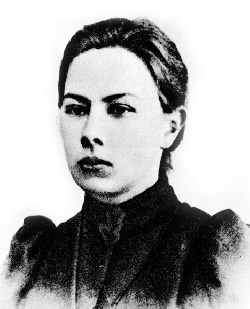
Having parents who were well educated, and of aristocratic descent, combined with firsthand experience with lower class working conditions probably led to the formation of many of Nadya’s ideological beliefs. “From her very childhood Krupskaya was inspired with the spirit of protest against the ugly life around her.”C. Bobrovskaija, Lenin and Krupskaja (New York City : Workers Library Publishers, Inc., 1940), 4.
One of Nadya’s friends from gymnasium, Ariadne Tyrkova, described Krupskaya as “a tall, quiet girl, who did not flirt with the boys, moved and thought with deliberation, and had already formed strong convictions… She was one of those who are forever committed, once they have been possessed by their thoughts and feelings….”McNeal, 19. Nadya briefly attended two different secondary schools before finding the perfect fit with Prince A.A. Obolensky’s Female Gymnasium, “a distinguished private girls’ secondary school in Petersburg.” This education was probably more liberal than most other gymnasiums since it was noted that some of the staff were former revolutionaries.McNeal, 17–19.
After her father’s death, Krupskaya and her mother gave lessons as a source of income. Krupskaya had expressed an interest in entering the education field from a young age. She was particularly drawn to Tolstoy’s theories on education, which were fluid instead of structured. They focused on the personal development of each individual student and centered on the importance of the teacher-student relationship.Tolstoy, Leo. In Encyclopædia Britannica. Retrieved March 21, 2008, from
This led Krupskaya to study many of Tolstoy’s works, including his theories of reformation. These were peaceful, law abiding ideas, which focused on people abstaining from unneeded luxuries and being self-dependent instead of hiring someone else to tend their house, etc. Tolstoy made a lasting impression on Krupskaya; it was said that she had “a special contempt for stylish clothes and comfort.”McNeal, 23. She was always modest in dress, as were her furnishings in her home and office.
As a devoted, lifelong student, Krupskaya began to participate in several discussion circles. These groups got together to study and discuss particular topics for the benefit of everyone involved. It was later, in one of these circles, that Krupskaya was first introduced to the theories of Marx. This piqued her interest as a potential way of making life better for her people. Krupskaya began an in-depth study of the subject. This was difficult since such books had been banned by the Russian government. Consequently, revolutionaries had been collecting such books and keeping them in underground libraries.
Soviet education and libraries
Before the revolution, Krupskaya worked five years as an instructor for a factory owner who offered evening classes for his employees. Legally, reading, writing and arithmetic were taught. Illegally, classes with a revolutionary influence were taught for those students who might be ready for them. Krupskaya and other instructors were relieved of duty when nearly 30,000 factory workers in the area went on strike for better wages.Raymond, 53–55 Even after the revolution her emphasis was on “the problems of youth organization and education.”McNeal, 173 In order to become educated they needed better access to books and materials.Raymond, 171.
Pre-revolutionary Russian libraries had a tendency to exclude particular members. Some were exclusively for higher classes and some were only for employees of a particular company’s "Trade Unions". In addition they also had narrow, Orthodox literature. It was hard to find any books with new ideas, which is exactly why the underground libraries began. Another problem was the low level of literacy of the masses.
The revolution did not cause an overnight improvement in the libraries. In fact, for a while there were even more problems. The Trade Unions still refused to allow general public use, funds for purchasing books and materials were in short supply and books that were already a part of the libraries were falling apart. In addition there was a low interest in the library career field due to low income and the libraries were sorely in need of re-organization.
Continue reading: part 3 of 3 →
