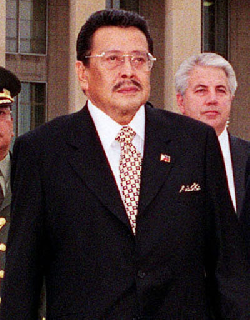
Joseph Estrada Part 4
President of the Philippines
- Life
- April 19, 1937
- Birthday
- April 19
- Length
- 5 parts
Domestic policies
Foreign policies
Economy
In October 2000, Ilocos Sur governor Luis "Chavit" Singson, a close friend of the President, alleged that he had personally given Estrada P400 million as payoff from jueteng hidden in a bank account known as "Jose Velarde" – a grassroots-based numbers game, as well as P180 million from the government price subsidy for the tobacco farmers' marketing cooperative after Estrada ordered a full blown investigation into Chavit Singson's alleged misuse of millions of pesos in public funds. Singson's allegation caused controversy across the nation, which culminated in the House of Representatives' filing of an impeachment case against Estrada on November 13, 2000. House Speaker Manny Villar fast-tracked the impeachment complaint. The impeachment suit was brought to the Senate and an impeachment court was formed, with Chief Justice Hilario Davide, Jr. as presiding officer. Estrada, pleaded “not guilty”.
This was the first time the Filipino public witnessed, through radio and television, an elected president stand in trial and face possible impeachment with full media coverage. During the trial, the prosecution presented witnesses and alleged evidences to the impeachment court regarding Estrada's alleged involvement in jueteng. The existence of secret bank accounts which he allegedly uses for receiving payoffs was also brought to the fore.
In the 2004 Global Transparency Report, Estrada made into the list of the World's All-Time Most Corrupt Leaders in the World. He was listed tenth and he was said to have amassed between $78 million to $80 million. Also making it to the list from the Philippines is Ferdinand Marcos,who ended up second in the list as he was said to have embezzled between $5 billion to $10 billion during his 21 years as President from 1965-1986.
EDSA II
Protests
On the evening of January 16, 2001, the impeachment court voted not to open an envelope that was alleged to contain incriminating evidence against the president simply because it was not part of the impeachment complaint. The final vote was 11–10, in favor of keeping the envelope closed. The prosecution panel (of congressmen and lawyers) walked out of the Impeachment Court in protest of this vote. The 11 senators who voted not to open the envelope are known as the "Craven Eleven." That night, anti-Estrada protesters gathered in front of the EDSA Shrine at Epifanio de los Santos Avenue, not too far away from the site of the 1986 People Power Revolution that overthrew Ferdinand Marcos.
On January 19, 2001, Armed Forces of the Philippines Chief of Staff Angelo Reyes, seeing the political upheaval throughout the country, "decided to withdraw his support" from the president and transfer his allegiance to the vice president, Gloria Macapagal-Arroyo.
Resignation
The following day, the Supreme Court declared that the seat of presidency was vacant, saying that Estrada had constructively resigned his post. At noon, the Chief Justice swore in Gloria Macapagal-Arroyo as president of the Philippines. Before Estrada's departure from Malacañang, he issued the following press release:
Personal life
Estrada is the first President to have previously worked in the entertainment industry, and for being the first to sport any sort of facial hair during his term, specifically his mustaches.
Family
Estrada is married to the former First Lady-turned-senator Dr Luísa Pimentel and has three children with her:
- José "Jinggoy" Ejercito, Jr, Mayor of San Juan (1992–2001); Senator (2004–present) (married to Precy Vitug)
- Jackie Ejercito (married to Beaver Lopez, son of Meralco chairman Manuel Lopez)
- Jude Ejercito (married to Rowena Ocampo)
Joseph Estrada met his wife Loi while working as an orderly at the National Center for Mental Health (NCMH) in Mandaluyong City.
He also has five more children from several extramarital relationships:
Continue reading: part 5 of 5 →


