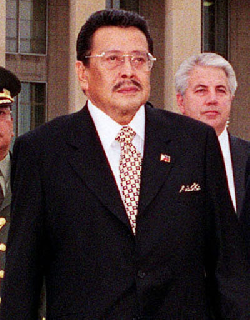
Joseph Estrada
President of the Philippines
- Life
- April 19, 1937
- Birthday
- April 19
- Length
- 5 parts
Estrada gained popularity as a film actor, playing the lead role in over 100 films in an acting career spanning 33 years. He used his popularity as an actor to make gains in politics, serving as mayor of San Juan for seventeen years, as Senator for one term, then as Vice President of the Philippines under the administration of President Fidel V. Ramos.
In 2007, he was sentenced by the special division of the Sandiganbayan to reclusion perpetua for plunder, but was later granted pardon by President Gloria Macapagal-Arroyo. He ran for president again in the 2010 presidential election, but placed second behind Senator Benigno Aquino III.
Awards and honors
- 1962 FAMAS Best Actor for Markang Rehashttp://erap.ph/
- 1964 FAMAS Best Actor for Geron Busabos
- 1965 FAMAS Best Actor for Ang Batang Quiapo
- 1966 FAMAS Best Actor for Ito ang Pilipino
- 1969 FAMAS Best Actor for Patria Adorada
- 1971 Outstanding Mayor and foremost Nationalist by the Inter-Provincial Information Service
- 1972 One of the Ten Outstanding Young Men (TOYM) in Public Administration by the Philippine Jaycees
- 1981 FAMAS Best Actor for Kumander Alibasbas
- 1981 FAMAS Hall of Fame
- 2007 Most Outstanding Citizen of San Juan
Early life and career
Joseph Ejercito Estrada was born on April 19, 1937 in Tondo, an urban district of Manila. His family later moved to the wealthy suburb of San Juan. He belonged to an upper-middle-class family, and was the eighth of ten children of Emilio Ejercito and his wife Maria Marcelo. He was kicked out during his primary studies at the Ateneo de Manila University and subsequently enrolled in an engineering course at the Mapua Institute of Technology in an effort to please his father, but dropped out.
In his twenties, he began a career as a drama actor. He adopted the stage name "Joseph Estrada", as his mother objected to his chosen career and his decision to quit schooling. He also acquired the nickname "Erap" (a play on the Tagalog slang "pare", meaning buddy) from his friend Fernando Poe, Jr..
Early political career
Mayor of San Juan
Estrada entered politics in 1967 when he ran for mayor of San Juan, then a municipality of Metro Manila, and succeeded in only 1969 after winning an electoral protest against Braulio Sto. Domingo. His administration was marked by unequaled accomplishments in infrastructure development. These included the establishment of the first Municipal High School, the Agora complex, a modern slaughterhouse, a sprawling government center with a post office, a mini-park and the concreting of 98 percent of the town's roads and alleys.
As mayor, he paid particular attention to the elementary education of children by improving and renovating school buildings and constructing additional school structures, health centers, barangay halls and playgrounds in all the barangays and providing artesian wells to areas with low water supply. He relocated some 1,800 squatter families out of San Juan to Taytay, Rizal, at no cost. He was also the first mayor to computerize assessment of the Real Estate Tax in the Municipal Assessor’s Office. When Corazon Aquino assumed the presidency in 1986, all elected officials of the local government were forcibly removed and replaced by appointed officers-in-charge, including Estrada.
Senator of the Philippines
The following year, he won a seat in the Senate under the Grand Alliance for Democracy (GAD) placing 16th in the elections (out of 24 winners). In 1987, he set his sights on a Senate run and handily garnered a seat. He was appointed Chairman of the Committee on Public Works. He was Vice-Chairman of the Committees on Health, Natural Resources and Ecology and Urban Planning.
In the Senate, Estrada was credited with the passage of, among other major pieces of legislation, the bills on irrigation project and the protection and propagation of carabaos, the beast of burden in the rural areas.
Continue reading: part 2 of 5 →


