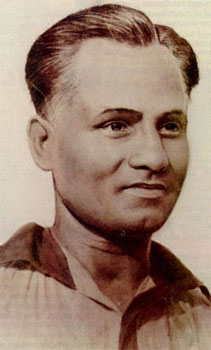
Dhyan Chand Part 3
Field hockey player
- Life
- 29 August 1905 - 3 December 1979
- Birthday
- August 29
- Length
- 5 parts
Captaincy and 1936 Berlin Summer Olympics
Indian hockey captain Dhyan Chand at 1936 Berlin Olympics
In 1933, Chand's home team, the Jhansi Heroes participated in and won the Beighton Cup, which he considered the most prestigious of Indian hockey tournaments. Later, he would state,
In Kolkata, the Heroes also won the Lakshmibilas Cup tournament, which was open only to Indian teams. In 1935, they successfully defended their Beighton Cup title, though lost the subsequent year.
In December 1934, the IHF decided to send a team to New Zealand in the new year. Chand and his brother were immediately selected. When the Nawab of Manavadar declined to play, Chand was appointed captain. In the subsequent tour, the team played a total of 48 matches on this tour, with 28 in New Zealand and the remainder in India, Ceylon and Australia. India won every match, scoring 584 goals and conceding only 40. Of these 48 matches, Chand played 43 and scored a total of 201 goals.
Upon returning to India, Chand resumed his duties in the barracks. In December, 1935 the IHF decided to stage the Inter-Provincial tournament to select the Olympic team. Chand was again denied permission to leave his platoon, though once again he was selected without formalities. The final team assembled in Delhi on 16 June and played against the Delhi Hockey XI. Incredibly, they lost 4-1. After this inauspicious start, the team went on a successful tour of the subcontinent, finally departing for Marseilles on 27 June. They arrived on 10 July, and after an uncomfortable journey in third-class compartments, reached Berlin on 13 July. On 17 July, the Indian team played a practice match against Germany and lost 4-1. As such, manager Pankaj Gupta informed the IHF that Ali Dara had to be sent immediately to replace the out of form Mirza Masood.
On 5 August, India won its first match against Hungary 4-0. India won the rest of the group matches against USA (7-0, with Chand scoring 2 goals) and Japan (9-0, with Chand scoring 4). On 10 August, Ali Dara arrived. Their fourth match was the semi-final against France, whom they defeated 10-0, with Chand scoring 4 goals. Meanwhile, Germany had beaten Denmark 6-0, beaten Afghanistan 4-1 and in the play-offs, had defeated Holland 3-0. Thus, India and Germany were to clash in the 1936 Berlin Olympics field hockey final on 15 August.
Dhyan Chand scoring a goal against Germany in the 1936 Olympics hockey final
On the morning of the final, the entire team was nervous since they had been defeated the last time they had faced Germany. In the locker room, Pankaj Gupta produced a Congress tricolour. Reverently the team saluted it, prayed and marched onto the field. The German team was successful in restricting the India side to a single goal until the first interval. After the interval, the Indian team launched an all-out attack, easily defeating Germany 8-1, incidentally the only goal scored against India in that Olympic tournament. Chand top-scored with 3 goals, Dara scored 2 and Roop Singh, Tapsell and Jaffar one each. Describing the game, the Special Correspondent of The Hindu wrote,
There have been many erroneous media reports over the years claiming that Dhyan Chand scored 6 goals in India's 8-1 victory over Germany in the 1936 Olympic final. However, Major Dhyan Chand in his autobiography titled “Goal!” published in 1952 by Sport & Pastime, Chennai, writes as follows:
“When Germany was four goals down, a ball hit Allen's pad and rebounded. The Germans took full advantage of this and made a rush, netting the ball before we could stop it. That was the only goal Germany would score in the match against our eight, and incidentally the only goal scored against India in the entire Olympic tournament. India's goal-getters were Roop Singh, Tapsell and Jaffar with one each, Dara two and myself three.”
The record for most goals by an individual in an Olympic final has belonged to Balbir Singh, Sr. another famous Indian hockey hero since the 1952 Helsinki Olympic games. He set this record by scoring 5 goals in India's 6-1 victory over Holland for the gold medal win. The previous holder of this record was England's Reggie Pridmore with his 4 goals in England's 8-1 victory over Ireland in the 1908 Olympic final.
Continue reading: part 4 of 5 →