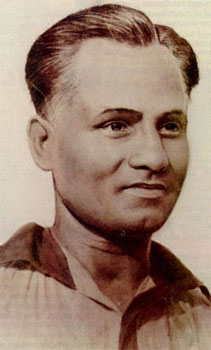
Dhyan Chand Part 2
Field hockey player
- Life
- 29 August 1905 - 3 December 1979
- Birthday
- August 29
- Length
- 5 parts
In the 1928 Amsterdam Summer Olympics, the Indian team was put in the division A table, with Austria, Belgium, Denmark and Switzerland . On 17 May the Indian national hockey team made its Olympic debut against Austria, winning 6-0, with Chand scoring 3 goals. The next day India defeated Belgium 9-0; however Chand only scored once. On 20 May, Denmark lost to India 5-0, with Chand netting 3. Two days later, he scored 4 goals when India defeated Switzerland 6-0 in the semi-finals.
The final match took place on 26 May, with India facing the home team of the Netherlands. The Indian team's better players Feroze Khan, Ali Shaukat and Kher Singh were on the sick list and Chand himself was ill. However, even with a skeletal side, India managed to defeat the hosts 3-0 (with Singh scoring 2), and the Indian team won its country's first Olympic gold medal. Keeper Richard Allen created a unique record of not conceding a single goal. Chand was the top scorer of the tournament by a large margin, scoring 14 goals in 5 matches. A newspaper report about India's triumph said, On returning to India, the team was received by thousands of people at the Bombay harbour, compared to the three people who had seen them off.
Posted in Waziristan in the North-West Frontier Province (now in Pakistan) with his new 2/14 Punjab Regiment, Chand was cut off from the IHF, which was by now controlled by civilians. The Inter-Provincial Tournament was being held to select the new Olympic team; the IHF wrote to the Army Sports Control Board to grant Singh leave to participate in the nationals. His platoon refused. Chand received news that he had been selected by the IHF for the Olympic team without any formalities. The rest of his teammates however, had to prove their skills in the Inter-Provincial Tournament, which was won by Punjab. As such, seven players from Punjab were selected for the Olympic team. Apart from Chand, Broome Eric Pinnigar, Leslie Hammond and Richard Allen were the other 1928 Olympians retained in the team. Chand's brother Roop Singh was also included in the squad as a left-in. Lal Shah Bokhari was selected as captain.
The Olympic team then played practice matches in India before heading for Colombo. In two matches in Ceylon, the Olympic team beat the All Ceylon XI 20-0 and 10-0. Wrote one newspaper on the first match, "Perfection is perilous, for it tempts the gods. For once, this was proved wrong for even the god of weather paid tribute to the genius of the Indian players. Rain clouds, which had threatened to ruin the game, vanished into the blue, and thousands of spectators spent a happy hour marvelling at the incomparable artistry of the Indian team."
The India team set sail for San Francisco on 30 May, and arrived on 6 June. They reached Los Angeles three weeks before the opening ceremony of the Olympics, which took place on 30 July. On 4 August 1932, India played its first match against Japan and won 11-1. Chand, Roop Singh, Gurmit Singh each scored thrice, and Dickie Carr once. In the final on 11 August, India played against hosts USA. India won 24-1, a world record at that time, and once again clinched the gold medal. Chand scored 8 times, Roop Singh 10, Gurmit Singh 5 and Pinniger once. In fact, Chand along with his brother Roop, scored 25 out of the 35 goals scored by India. This led to them being dubbed the 'hockey twins'.
One Los Angeles newspaper wrote, "The All-India field hockey team which G. D. Sondhi brought to Los Angeles to defend their 1928 Olympic title, was like a typhoon out of the east. They trampled under their feet and all but shoved out of the Olympic stadium the eleven players representing the United States."
The team then embarked on a tour of the United States. They played a match on 20 August against a United States XI, almost the same team that they had faced in Los Angeles. Even after loaning its second keeper Arthur Hind, for a half, the team won 24-1.
After setting sail from New York, the team arrived at England.The then embarked on a hectic tour, playing nine matches in various countries in a fortnight, commencing on 2 September. They played four internationals-against Holland, Germany, Czechoslovakia and Hungary. The team then reached Ceylon and India, playing a number of matches to pay for their expenses. At the end of the tour, India had played 37 matches, winning 34, drawing 2, with one abandoned. Chand scored 133 of the 338 Indian goals.
Continue reading: part 3 of 5 →