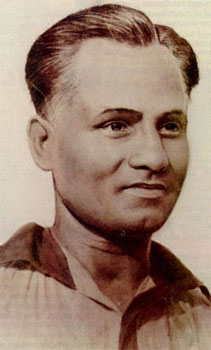
Dhyan Chand
Field hockey player
- Life
- 29 August 1905 - 3 December 1979
- Birthday
- August 29
- Length
- 5 parts
Dhyan Chand (29 August 1905 – 3 December 1979) was an Indian field hockey player widely considered to be one of the greatest players of all time. Chand is most remembered for his goal-scoring feats and for his three Olympic gold medals (1928, 1932, and 1936) in field hockey, during an era where India was dominant in the sport.
Known as “The Wizard” for his superb ball control, Chand played his final international match in 1948, having scored more than 400 goals during his international career.
Early life
Dhyan Chand was born in Allahabad, in a bais rajput family. He was the elder brother of another player Roop Singh. His father Sameshwar Dutt Singh was in the British Indian Army, and he played hockey in the army. Dhyan Chand had two brothers - Mool Singh, and Roop Singh. Because of Sameshwar Dutt's numerous army transfers, the family had to move to different cities and as such Chand had to terminate his education after only six years of schooling. The family finally settled in Jhansi, Uttar Pradesh, India. Being in the military, Dhyan's father got a small piece of land for a house.
Young Chand had no serious inclination towards sports, though he loved wrestling. He stated that he did not remember whether he played any hockey worth mentioning before he joined the Army, though he said that he occasionally indulged in casual games in Jhansi with his friends.
Chand joined the Indian Army at the age of 16, The Hindi word Chand literally means the moon. Since Dhyan Singh used to practice a lot during night after his duty hours, he invariably used to wait for the moon to come out so that the visibility in the field (during his era there were no flood lights) improved. Hence he was called "Chand", by his fellow players, as his practice sessions at night invariably coincided with the coming out from the moon.
Between 1922 and 1926, Chand exclusively played army hockey tournaments and regimental games. Chand was ultimately selected for the Indian Army team which was to tour New Zealand. The team won 18 matches, drew 2 and lost only 1, receiving praise from all spectators. Following this, in the two Test matches against the New Zealand squad, the team won the first and narrowly lost the second. Returning to India, Chand was immediately promoted to Lance Naik.
After successfully lobbying for reintroducing field hockey in the Olympics, the newly formed Indian Hockey Federation (IHF) made preparations to send its best possible team for the 1928 Amsterdam Olympics. In 1925, an Inter-Provincial Tournament was held to select India's national field hockey team. Five teams participated in the inaugural nationals - United Provinces (UP), Punjab, Bengal, Rajputana and Central Provinces. Chand got permission from the Army to play for the United Provinces team.Amstedam was bad match. later he won.
In its first game in the tournament. Dhyan Chand as the centre-forward, and Marthins, their inside-right, were particularly happy in their understanding of each other. Dhyan Chand attracted much attention by his clever stickwork. His penetrating runs and judicious passes seemed to assure for him a position in the team that is to take part in the Olympic Games.
Quite early in the game, it became evident that Dhyan Chand was again at his best. In combination with Marthins he took the ball away to the right and Marthins did well to give him a good pass. Quick as lightning, Dhyan Chand shot a goal. The ball struck one of the defenders' stick and went into the net, giving goalkeeper Collie no chance. A goal within 3 minutes of the start was more than what the most optimistic of the UP supporters could expect. At the interval, UP led by three goals to nil.
On their part, Rajputana put every ounce of their efforts to score. The UP goal had more than one narrow escape, but they were deserving winners of a fine exhibition match. UP 3 - Rajputana 1.
Buoyed by the success of the Tournament, it was decided that it would be held every two years. After two more trial matches between various hopefuls, the Olympic team (including Chands as center-forward) was announced and assembled in Bombay. Center-half Broome Eric Pinniger was selected as the captain. The IHF was initially low on funds since the provinces of Bombay, Madras and Burma had turned a deaf ear to their financial appeal, but they managed to scrape enough money. The Olympic team then played a match against the Bombay XI, and amazingly lost 3-2, even though Singh scored both his team's goals. With a quiet send-off, the team left for England on 10 March, to play 11 matches against local sides as well in the Folkestone Festival, winning all. Finally, on 24 April, the team arrived in Amsterdam to embark on a tour of the Low Countries. In all the pre-Olympic matches against local Dutch, German and Belgian teams, the Indian team won by large margins.
Continue reading: part 2 of 5 →