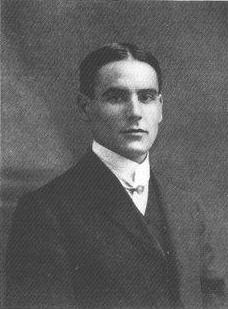
William Hope Hodgson Part 3
Science - Other
- Life
- 15 November 1877 – 1918
- Birthday
- November 15
- Field
- Science - Other
- Length
- 7 parts
This story proved an emotional testament beyond all other evidence. Hodgson, whose literary success would be in a large measure based on the impressions he received at sea, actually hated and feared the waters with an intensity that was the passion of his life.
Also in 1909, Hodgson published another novel, The Ghost Pirates. In the foreword, he wrote that it
… completes what, perhaps, may be termed a trilogy; for, though very different in scope, each of the three books deals with certain conceptions that have an elemental kinship. This book, the author believes that he closes the door, so far as he is concerned, on a particular phase of constructive thought.
The Bookman magazine in its review of the novel in 1909 included the comment:
We can only hope that Mr. Hodgson may be induced to reconsider his decision, for we know of nothing like the author’s previous work in the whole of present-day literature.
Despite the critical success of his novels, Hodgson remained relatively poor. To try to bolster his income from short story sales, he began working on the first of his recurring characters: the Carnacki character, featured in several of his most famous stories and partly inspired by Algernon Blackwood’s occult detective John Silence. The first of these, "The Gateway of the Monster", was published in 1910 in The Idler. In 1910 Hodgson also published "The Captain of the Onion Boat", an unusual story that combines a nautical tale and a romance. He continued to publish many stories and non-fiction pieces, occasionally resorting to the use of recycled plot elements and situations, sometimes to the annoyance of his publishers.
His last novel to see publication, The Night Land, was published in 1912, although it likely had its genesis a number of years earlier. Hodgson also worked on a 10,000-word novelette version of the novel, now known as The Dream of X. He continued to branch out into related genres, publishing "Judge Barclay’s Wife", a western adventure, in the United States, as well as several non-supernatural mystery stories and the science fiction story "The Derelict", and even war stories (several of the Captain Gault tales feature wartime themes).
In 1912, Hodgson married Betty Farnworth, known also as Bessie, a girl from Cheadle Hulme and a staff member who wrote the ‘agony’ column for the women’s magazine Home Notes. Both were thirty-five. She gave up her job after they married on 26 February 1913, in the London borough of Kensington. They moved to the south of France and took up residence there, owing in part to the low cost of living. Hodgson began a work entitled "Captain Dang (An account of certain peculiar and somewhat memorable adventures)" and continued to publish stories in multiple genres, although financial security continued to elude him. When war broke out in Europe,the Hodgsons returned to England.
Later life, World War I experience and death
Hodgson returned with his wife to England. He joined the University of London’s Officer’s Training Corps. Refusing to have anything to do with the sea despite his experience and Third Mate’s certificate, he received a commission as a Lieutenant in the Royal Artillery. In 1916 he was thrown from a horse and suffered a broken jaw and a serious head injury; he received a mandatory discharge, and returned to writing.
Refusing to remain on the sidelines, Hodgson recovered sufficiently to re-enlist. His published articles and stories from the time reflect his experience in war. He was killed by an artillery shell at Ypres in April 1918; sources suggest either the 17th or 19th. He was eulogized in The Times on 2 May 1918. The American magazine Adventure, to which Hodgson had contributed fiction, also ran an obituary which reprinted a clipping from his widow, describing how Hodgson led a group of NCOs to safety under heavy fire.Jones, Robert Kenneth. The Lure of "Adventure". Starmont House,1989, (p. 8-9). ISBN 1-55742-142-0
Continue reading: part 4 of 7 →


