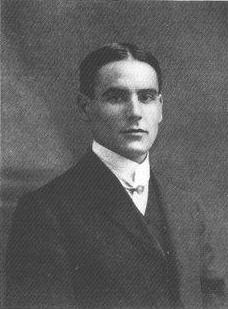
William Hope Hodgson Part 2
Science - Other
- Life
- 15 November 1877 – 1918
- Birthday
- November 15
- Field
- Science - Other
- Length
- 7 parts
Hodgson was not shy of publicity, and in another notable stunt, rode a bicycle down a street so steep that it had stairs, an event written up in the local paper. Despite his reputation, he eventually found that he could not earn a living running his personal training business, which was seasonal in nature, and shut it down. He began instead writing articles such as "Physical Culture versus Recreative Exercises" (published in 1903). One of these articles, "Health from Scientific Exercise," featured photographs of Hodgson himself demonstrating his exercises. The market for such articles seemed to be limited, however; so, inspired by authors such as Edgar Allan Poe, H. G. Wells, Jules Verne and Arthur Conan Doyle,Wisker, Gina. Horror fiction: An Introduction. Continuum International Publishing Group, 2005. ISBN 0-8264-1561-X. pp. 75–76 Hodgson turned his attention to fiction, publishing his first short story, "The Goddess of Death", in 1904, followed shortly by "A Tropical Horror". He also contributed to an article in The Grand Magazine, taking the "No" side in a debate on the topic "Is the Mercantile Navy Worth Joining?" In this piece, Hodgson laid out in detail his negative experiences at sea, including facts and figures about salaries. This led to a second article in The Nautical Magazine, an exposé on the subject of apprenticeships; at the time, families often were forced to pay to have boys accepted as apprentices. Hodgson began to give paid lectures, illustrated with his photography in the form of colorized slides, about his experiences at sea.
Although he wrote a number of poems, only a handful were published during his lifetime; several, such as "Madre Mia", appeared as dedications to his novels. Apparently cynical about the prospects of publishing his poetry, in 1906 he published an article in The Author magazine, suggesting that poets could earn money by writing inscriptions for tombstones. Many of his poems were published by his widow in two posthumous collections, but some 48 poems were not published until their appearance in the 2005 collection The Lost Poetry of William Hope Hodgson.
Career in fiction, and marriage
Hodgson’s first short story was "The Goddess of Death" (1904), in which he utilised a statue of Flora which stood in Blackburn Park as the focus of a tale in which a Hindu statue, seized from an Indian temple, stood in a small English town. The statue comes alive to take its revenge on the people who stole it. The Royal Magazine published the story in April 1904.
In 1906 the American magazine The Monthly Story Magazine published "From the Tideless Sea"", the first of Hodgson’s Sargasso Sea stories. Hodgson continued to sell stories to American magazines as well as British magazines for the remainder of his career, carefully managing the rights to his work in order to maximize his remuneration.
While still living with his mother in relative poverty, his first published novel, The Boats of the "Glen Carrig", appeared in 1907, to positive reviews. Hodgson also published ‘"The Voice in the Night" the same year, as well as "Through the Vortex of a Cyclone", a realistic story inspired by Hodgson’s experiences at sea and illustrated with tinted slides made from his own photographs. Hodgson also explored the subject of ships and cyclones in his story "The Shamraken Homeward-Bounder", published in 1908. Also in 1908, Hodgson published his second novel, The House on the Borderland, again to positive reviews, as well as an unusual satirical science fiction story, "Date 1965: Modern Warfare", a Swiftian satire in which it is suggested that war should be carried out by men fighting in pens with knives, and the corpses carefully salvaged for food, although in letters to the editor published at the time, he expressed strong patriotic sentiments.
In 1909, he published "Out of the Storm", a short horror story about "the death-side of the sea," in which the protagonist drowning in a storm rants about the horrors of a storm at sea. According to Moskowitz,
Continue reading: part 3 of 7 →


