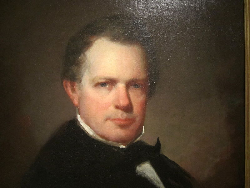
William Gilmore Simms Part 3
American writer
- Life
- April 17, 1806 - June 11, 1870
- Birthday
- April 17
- Length
- 3 parts
Critical response and legacy
The Battery in Charleston, South Carolina]]
By the mid-1840s, Simms's fame for his novels was so great that Edgar Allan Poe declared Simms to be "The best novelist which this country has, on the whole, produced"Review by Edgar Allan Poe in Broadway Journal, September 20, 1845. and "immeasurably the greatest writer of fiction in America".Nelson, Randy F. The Almanac of American Letters. Los Altos, California: William Kaufmann, Inc., 1981: 164. ISBN 0-86576-008-X Simms's story collection The Wigwam and the Cabin was singled out by Poe as "decidedly the most American of American books".Widmer, Edward L. Young America: Flowering of Democracy in New York City. New York: Oxford University Press, 1999: 108. ISBN 0-19-514062-1 However, despite having achieved a very good literary reputation during his lifetime, today Simms' novels are, for the most part, out of print. Eminent Simms scholar Dr. David Aiken has observed that Simms was purged from the canon of American literature because of the "unpardonable sin Simms committed when he published an account of Columbia's destruction in which he dared to deny the North a righteous victory"Aiken, David. Introduction to A City Laid Waste: The Capture Sack and Destruction of the City of Columbia. Columbia, South Carolina: University of South Carolina Press, 2005: 41. ISBN 1-57003-596-2 as Simms asserted of the North's tactics in the Civil War, "whatever might have existed in virtue of their cause, is forfeit by the processes which they have taken for its maintainance".Simms, William G. A City Laid Waste: The Capture Sack and Destruction of the City of Columbia. Columbia, South Carolina: University of South Carolina Press, 2005: 110. ISBN 1-57003-596-2 Donald Davidson claimed, "The neglect of Simms' stature is nothing less than a scandal when it results....in the disappearance of his books from the common market and therefore from the readers' bookshelf. This is literary murder".Mary C. Simms Oliphant, Alfred Taylor Odell, and T.C. Duncan Eaves, eds., The Letters of William Gilmore Simms, 6 vols. Columbia, South Carolina: University of South Carolina Press, 1952-1956, 1983: vol. I, xxxii Still, he is known among literary scholars as a major force in Antebellum literature., and though his outstanding genius and literary accomplishments have been largely overlooked, this has caused Simms to come to embody the "outsider" nature of contemporary Southern fiction.
Dr. Mary Ann Wimsatt, the major Simms scholar of her generation, has published dozens of articles and two widely praised books about the author. The first book, The Major Fiction of William Gilmore Simms, was published by Louisiana State University Press in 1989. The second, an edition of twelve Simms short stories titled Tales of the South, was published by the University of South Carolina Press in 1996. A reviewer in The Virginia Quarterly Review styled Wimsatt's edition magisterial.
A large bust of Simms is centrally located in Charleston's Battery Park.


