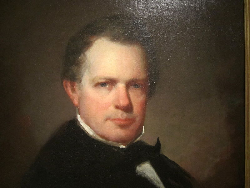
William Gilmore Simms Part 2
American writer
- Life
- April 17, 1806 - June 11, 1870
- Birthday
- April 17
- Length
- 3 parts
As historian
Simms, circa 1860
Simms was one of the best, and most respected, historians of his day. His History of South Carolina (1842) served for several generations as the standard school textbook on the state's history. He also wrote enormously popular biographies of Revolutionary War heroes Francis Marion, Nathanael Greene, and John Laurens, as well as John Smith and the Chevalier Bayard. Additionally, Simms was a popular lecturer on American history and accumulated one of the largest collections of Revolutionary War manuscripts. Unfortunately, most of this collection was lost when Sherman's army burned his home.Busick, Sean R. A Sober Desire for History: William Gilmore Simms as Historian., 2005. ISBN 1-57003-565-2.
Pro-slavery writings
Simms is also remembered today for his strong support of slavery and for his opposition to Harriet Beecher Stowe's abolitionist novel Uncle Tom's Cabin, in response to which he wrote reviews and a book. His Anti-Tom novel was The Sword and the Distaff.
Even though The Sword and the Distaff came out only a few months after Stowe's novel, it contains a number of sections and discussions that are clearly debating Stowe's book and view of slavery. The novel focuses on the Revolutionary War and its aftermath through the lives of Captain Porgy and one of his slaves. Many of Simms' other writings took a similar pro-slavery viewpoint. by Lucinda MacKethan, North Carolina State University, originally published in Southern Spaces, accessed Feb. 17, 2007.
Simms' book was one of between twenty and thirty Anti-Tom novels written after Stowe's book. As in Simms' book, these novels tended to feature a benign white patriarchal master and a pure wife, both of whom presided over childlike slaves in a benevolent extended-family-style plantation. Simms' novel was popular enough that it was reprinted in 1854 under the title Woodcraft."" by Philip D. Beidler. Alabama Heritage Number 75, Winter 2005. Accessed 2/7/2006.
Later life
In Simms' later years, he became part of the Southern plantation class and firmly supported slavery and Southern secession. During the American Civil War, Simms espoused the side of the Secessionists in a weekly newspaper and suffered damage at the hands of the Federal troops when they entered Charleston. He served in the state House of Representatives in 1844–1846, after which he was defeated in the election for lieutenant governor by only one vote. The University of Alabama conferred on him the degree of LL.D. He wrote little after the Civil War, though he compiled an anthology of Southern war poems in 1866.Coulter, E. Merton. The South During Reconstruction, 1865–1877. Louisiana State University Press, 1947: 280. ISBN 0-8071-0008-0 Simms died at his home at 13 Society Street in Charleston on June 11, 1870. He is buried in Magnolia Cemetery.
List of works
- Monody, on the Death of Gen. Charles Cotesworth Pinckney (1825)
- Lyrical and Other Poems (1827)
- Tile Vision of Cones, Cain, and Other Poems (1829)
- The Tricolor, or Three Days of Blood in Paris (1830)
- Atalantis, a Tale of the Sea (1832).
- Martin Faber, the Story of a Criminal (1833)
- The Yemassee (1835)
- The Partisan (1835)
- Pelayo: a Story of the Goth (1838)
- Mellichampe (1836)
- Richard Hurdis; or, the Avenger of Blood. A Tale of Alabama (1838)
- Border Beagles: A Tale of Mississippi (1840)
- The Kinsmen (1841)
- History of South Carolina (1842)
- The Lily and the Totem, or, The Huguenots in Florida (1850)
- Katherine Walton (1851)
- The Tennessean's Story (1852)
- The Golden Christmas (1852)
- Vasconselos (1853)
- Woodcraft (1854)
- The Forayers (1855)
- Eutaw (1856)
- The Cassique of Kiawah (1859)
- A City Laid Waste: The Capture, Sack, and Destruction of the City of Columbia (1865)
- Joscelyn (1867)


