Young also pushed for federal aid to cities, proposing a domestic "Marshall Plan". This plan, which called for $145 billion in spending over 10 years, was partially incorporated into President Lyndon B. Johnson’s War on Poverty. Young described his proposals for integration, social programs, and affirmative action in his two books, To Be Equal (1964) and Beyond Racism (1969).
As executive director of the League, Young pushed major corporations to hire more blacks. In doing so, he fostered close relationships with CEOs such as Henry Ford II, leading some blacks to charge that Young had sold out to the white establishment. Young denied these charges and stressed the importance of working within the system to effect change. Still, Young was not afraid to take a bold stand in favor of civil rights. For instance, in 1963, Young was one of the organizers of the March on Washington despite the opposition of many white business leaders.
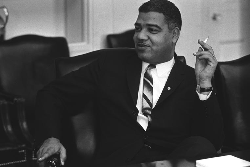
The Treatment" from President Johnson (1966)]]
Despite his reluctance to enter politics himself, Young was an important advisor to Presidents Kennedy, Johnson, and Nixon. In 1968, representatives of President-elect Richard Nixon tried to interest Young in a Cabinet post, but Young refused, believing that he could accomplish more through the Urban League.Whitney M. Young, Jr. and the Struggle for Civil Rights, Nancy J. Weiss, p. 192
Young had a particularly close relationship with President Johnson, and in 1969, Johnson honored Young with the highest civilian award, the Presidential Medal of Freedom. Young, in turn, was impressed by Johnson’s commitment to civil rights.
Despite their close personal relationship, Young was frustrated by Johnson’s attempts to use him to balance Martin Luther King’s opposition to the increasingly unpopular Vietnam War.Whitney M. Young, Jr. and the Struggle for Civil Rights, Nancy J. Weiss, p. 163 Young publicly supported Johnson’s war policy, but came to oppose the war after the end of Johnson’s presidency.
In 1968, Herman B. Furguson and Arthur Harris were convicted of conspiring to murder Young as part of what was described as a "black revolutionary plot." The trial took place in the New York State Supreme Court, with Justice Paul Balsam presiding.See "Paul Balsam Dead; A Justice In Queens," The New York Times, December 24, 1972, available for purchase at
Legacy
Whitney Young’s legacy, as President Nixon stated in his eulogy, was that "he knew how to accomplish what other people were merely for." Young’s work was instrumental in breaking down the barriers of segregation and inequality that held back African Americans.
Hundreds of schools and other sites are named for Young. For instance, in 1973, the East Capitol Street Bridge in Washington, D.C., was renamed the Whitney Young Memorial Bridge in his honor.
Clark Atlanta University named its School of Social Work, where Whitney Young served as Dean, in Young’s honor. The Whitney M. Young School of Social Work is well known for founding the "Afro-Centric" perspective of social work.
The Boy Scouts of America created the Whitney M. Young Jr. Service Award to recognize outstanding services by an adult individual or an organization for demonstrated involvement in the development and implementation of Scouting opportunities for youth from rural or low-income urban backgrounds.
Whitney Young High School in Chicago was named after him. Whitney M. Young High School in Cleveland, Ohio was also named after him.
Young’s birthplace (Whitney Young Birthplace and Museum) in Shelby County, Kentucky is a designated National Historic Landmark, with a museum dedicated to Young’s life and achievements.
Young was honored on a United States Postage stamp as part of its on-going Black Heritage series.
In 1973, The African American MBA Association at The Wharton School, University of Pennsylvania held its first Annual Whitney M. Young Jr. Memorial Conference. After 38 years, the is the longest student-run conference held at The Wharton School.
Continue reading: part 3 of 3 →