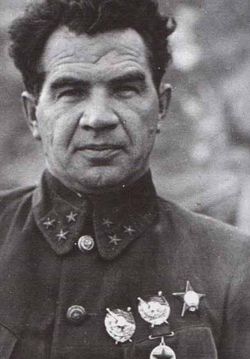
He was a major consultant for the design of the Stalingrad battle memorial on Mamayev Kurgan, and was buried there after his death at the age of 82.
Inter-war period
He left his regiment in 1921 to continue his studies at the Frunze Military Academy, from which he graduated in 1925.
Honours and awards
Soviet Union- Hero of the Soviet Union, twice (19 March 1944, 6 April 1945)
- Order of Lenin, nine times (26 October 1943, 19 March 1944, 21 February 1945, 11 February 1950, 11 February 1960, 12 February 1970, 11 February 1975, 21 February 1978, 11 February 1980)
- Order of the October Revolution (22 February 1968)
- Order of the Red Banner, four times (1920, 1925, 1944, 1948)
- Order of Suvorov, 1st class, three times (28 January 1943, 23 August 1944, 29 May 1945)
- Order of the Red Star (1940)
- Honorary arms with golden national emblem of the Soviet Union (22 February 1968)
- Jubilee Medal "In Commemoration of the 100th Anniversary since the Birth of Vladimir Il’ich Lenin"
- Medal "For the Defence of Stalingrad"
- Medal "For the Victory over Germany in the Great Patriotic War 1941–1945"
- Jubilee Medal "Twenty Years of Victory in the Great Patriotic War 1941-1945"
- Jubilee Medal "Thirty Years of Victory in the Great Patriotic War 1941-1945"
- Medal "For the Capture of Berlin"
- Medal "For the Liberation of Warsaw"
- Medal "Veteran of the Armed Forces of the USSR"
- Jubilee Medal "XX Years of the Workers’ and Peasants’ Red Army"
- Jubilee Medal "30 Years of the Soviet Army and Navy"
- Jubilee Medal "40 Years of the Armed Forces of the USSR"
- Jubilee Medal "50 Years of the Armed Forces of the USSR"
- Jubilee Medal "60 Years of the Armed Forces of the USSR"
- Order of Merit for the Fatherland in gold, twice (East Germany)
- Grand Cross of the Star of People’s Friendship (East Germany)
- Cross of Grunwald, 2nd class (Poland)
- Gold Cross of the Virtuti Militari (Poland)
- Commander’s Cross of the Order of Polonia Restituta (Poland)
- Order of Sukhbaatar (Mongolia)
- Two orders of China
- Distinguished Service Cross (United States)
Awards of other countries
Stalingrad
On returning to Moscow, Chuikov was placed in command of the 64th Army (later 7th Guards), on the west bank of the Don River. The 64th Army took part in the fighting withdrawal to Stalingrad, and shortly before the Battle of Stalingrad itself began, Chuikov was made commanding general of the more important 62nd Army, which was to hold Stalingrad itself, with the 64th on its southern flank.
It was at Stalingrad that Chuikov developed the important tactic of “hugging the enemy,” by which under-armed Soviet soldiers kept the German army so close to them as to minimize the superior firepower enjoyed by the Wehrmacht. Chuikov had witnessed firsthand the blitzkrieg tactics the Nazis had used to sweep across the Russian steppe, so he used the Germans’ carpet-bombing of the city to draw panzer units into the rubble and chaos, where their progress was impeded. Here they could be destroyed with Molotov cocktails and Russian artillery operating at close range. This tactic also rendered the German Luftwaffe ineffective, since Stuka dive-bombers could not attack Red Army positions without endangering their own forces.Craig, William (1973). Enemy at the Gates: the Battle for Stalingrad. New York: Penguin Books (ISBN 0-14-200000-0 & ISBN 1-56852-368-8).Beevor, Antony (1998). Stalingrad. New York: Viking (ISBN 0-14-024985-0).
After the victory at Stalingrad, the 62nd Army was redesignated the Soviet 8th Guards Army. Chuikov then commanded the 8th Guards as part of 1st Belorussian Front and led its advance through Poland, finally heading the Soviet offensive which conquered Berlin in April/May 1945.
Chuikov’s advance through Poland was characterized by massive advances across difficult terrain (on several occasions, the 8th Guards Army advanced over 40 miles in a single day). On May 1, 1945, Chuikov, who commanded his army operating in central Berlin, was the first Allied officer to learn about Adolf Hitler’s suicide, being informed by General Hans Krebs who had come to Chuikov’s headquarters under a white flag. He accepted the surrender of Berlin’s forces from General Helmuth Weidling.
Chuikov appeared in the documentary film Berlin (1945), directed by Yuli Raizman.


