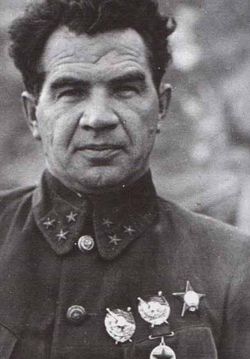
Vasily Ivanovich Chuikov (́лий Ива́нович Чуйко́в) (February 12, 1900 – March 18, 1982) was a Soviet lieutenant general in the Red Army during World War II, commander of the 62nd Army during the Battle of Stalingrad, twice Hero of the Soviet Union (1944, 1945), and after the war a Marshal of the Soviet Union.
Early life
Born into a peasant family in the village of Serebryanye Prudy in the Tula region south of Moscow, he was the eighth of twelve children and the fifth of eight sons. Chuikov and all his brothers became soldiers and fought in the Russian Civil War. At the age of twelve, he left school and his family home to earn his living in a factory in St. Petersburg, turning out spurs for cavalry officers.
Memoirs in translation
- The Beginning of the Road: The Story of the Battle for Stalingrad, London, 1963.Keegan, John. The Battle for History: Re-fighting World War Two (Barbara Frum lecture series), Vintage Canada, Toronto, 1995. Republished by Vintage Books, New York, 1996.
The Russian Revolution and Civil War
During the turmoil of the Russian Revolution of 1917, Chuikov became unemployed. Later the same year, an older brother arranged for Chuikov to be recruited into the Red Guards. The year after, in 1918, he joined the Red Army.
In October 1918, Chuikov saw active service when he was sent to the Southern Front as a deputy company commander to fight against the White Army. In the spring of 1919, he became commander of the 40th Regiment (later renamed the 43rd), part of the 5th Army under Tukhachevsky facing the White Army at Kolchak in Siberia.
Chuikov’s record of service during the Civil War was distinguished. In the fighting from 1919 to 1920 he received two awards of the Order of the Red Banner for bravery and heroism. He was wounded four times—one, in Poland in 1920, left a fragment in his left arm that could not be operated on. It led to partial paralysis and caused him to lose temporary use of his arm. Chuikov carried this war wound for the rest of his life, and it eventually led to septicaemia breaking out in 1981, causing a nine-month illness and finally his death.
Second World War
Chuikov commanded the 4th Army in the Soviet invasion of Poland in 1939. He commanded the 9th Army in the Russo-Finnish War of 1940. His army was defeated by the Finns at Suomussalmi and Raate Road. He was then sent to China as an adviser to Chiang Kai-shek. In May 1942, the USSR recalled him. According to Chuikov’s memoirs, his recall was due to Nationalist China claiming that the USSR was providing military aid as part of an attempt to draw the USSR into the Second Sino-Japanese War.
In popular culture
- Chuikov was briefly featured in the 2004 German-Austrian movie Downfall (Der Untergang), dealing with the fall of Berlin in 1945. He was portrayed by a Russian actor Aleksandr Slastin.
- In Dana Kramer-Rolls’ novel Home Is the Hunter, Star Trek character Pavel Chekov refer to Chuikov as his ancestor (although "Vasily" is spelled as "Vassili").
- Chuikov is a character in Robert Conroy’s Red Inferno: 1945. The novel follows his career alongside Marshal of the Soviet Union Georgy Zhukov in a fictional situation where the Soviet Union attacks America and the remaining Allied nations. Towards the end, an American Boeing B-29 Superfortress drops a nuclear bomb near the city of Paderborn, Germany, where he is stationed, killing him, Zhukov, and a large portion of the Soviet military’s elite forces.
Later life
After the war, Chuikov stayed in Germany, later serving as Commander-in-Chief of the Group of Soviet Forces in Germany from 1949 until 1953, when he was made the Commanding General of the Kiev Military District. While serving at that post, on March 11, 1955 he was promoted to Marshal of the Soviet Union. From 1960 to 1964, he was the Commander-in-Chief of the Soviet Army’s Ground Forces. He also served as the Chief of the Civil Defense from 1961 until his retirement in 1972. From 1961 until his death, he was a member of the Central Committee of the Communist Party of the Soviet Union.
Continue reading: part 2 of 2 →


