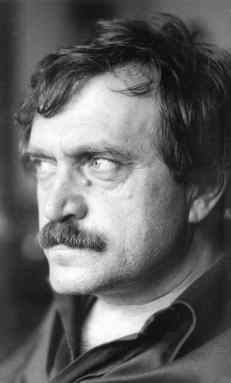
Vasily Aksyonov Part 2
Soviet writer
- Life
- August 20, 1932 – July 6, 2009
- Birthday
- August 20
- Field
- Art, Literature
- Length
- 3 parts
"When The Burn was published in Italy in 1980, Aksyonov accepted an invitation for him and his wife Maya to leave Russia for the US." "Soon afterwards, he was stripped of his Soviet citizenship, regaining it only 10 years later during Gorbachev’s perestroika."
"Aksyonov spent the next 24 years in Washington, D.C. and Virginia, where he taught Russian Literature at George Mason University."Vasily Aksyonov, 76, Exiled Soviet Writer. SOPHIA KISHKOVSKY. The New York Times July 8, 2009. Section A; Column 0; Obituary; Pg. 23. "He [also] taught literature at a number of [other] American universities, including USC and Goucher College in Maryland . . . [and] worked as a journalist for Radio Liberty."OBITUARIES / VASILY AKSYONOV, 1932 – 2009; Dissident writer was expelled from the Soviet Union Los Angeles Times July 10, 2009. MAIN NEWS; Metro Desk; Part A; Pg. 26.
"He continued to write novels, among which was the ambitious Generations of Winter (1994), a multi-generational saga of Soviet life that became a successful Russian TV mini-series." The so-called "The Moscow Saga, [this 1994] epic trilogy . . . described the lives of three generations of a Soviet family between the 1917 Bolshevik Revolution and Stalin’s death in 1953." The TV mini-series consisted of 24 episodes and was broadcast on Russian television in 2004. "[In 1994], he also won the Russian Booker Prize, Russia’s top literary award, for his historical novel Voltairian Men and Women, about a meeting between the famous philosopher Voltaire and Empress Catherine II."
"In 2004, he settled in Biarritz, France, and returned to the US less frequently, dividing his time between France and Moscow." His novel Moskva-kva-kva (2006) was published in the Moscow-based magazine Oktyabr.
"Aksyonov was translated into numerous languages, and in Russia remained influential." He was reportedly "forever a hipster [and] was used to being in the avant garde, be it in fashion or literary innovation." He was described as "a colourful man, with his trademark moustache, elegant suits, expensive cars, and a love for grand cities, fine wine and good food."
On July 6, 2009, he died in Moscow at the age of 76 and is "survived by Maya and a son, Aleksei."
Early life
Vasily Aksyonov was born to Pavel Aksyonov and Yevgenia Ginzburg in Kazan, USSR on August 20, 1932. His mother, Yevgenia Ginzburg, was a successful journalist and educator and his father, Pavel Aksyonov, had a high position in the administration of Kazan. Both parents "were prominent communists." In 1937, however, both were arrested and tried for her alleged connection to Trotskyists. They were both sent to Gulag and then to exile, and "each served 18 years, but remarkably survived." "Later, Yevgenia came to prominence as the author of a famous memoir, Into the Whirlwind, documenting the brutality of Stalinist repression."
Aksyonov remained in Kazan with his nanny and grandmother until the NKVD arrested him as a son of "enemies of the people", and sent him to an orphanage without providing his family any information on his whereabouts. Aksyonov "remained [there] until rescued in 1938 by his uncle, with whose family he stayed until his mother was released into exile, having served 10 years of forced labour." "In 1947, Vasily joined her in exile in the notorious Magadan, Kolyma prison area, where he graduated from high school." Vasily’s half-brother Alexei (from Ginzburg’s first marriage to Dmitriy Fedorov) died from starvation in besieged Leningrad in 1941.
His parents, seeing that doctors had the best chance to survive in the camps, decided that Aksyonov should go into the medical profession. "He therefore entered the university in Kazan and graduated in 1956 from the Leningrad Medical Institute" and worked as a doctor for the next 3 years. During his time as a medical student he came under surveillance by the KGB, who began to prepare a file against him. It is likely that he would have been arrested had the liberalisation that followed Stalin’s death in 1953 not intervened.
Continue reading: part 3 of 3 →

