Thecla () was a saint of the early Christian Church, and a reported follower of Paul the Apostle. The only known record of her comes from the apocryphal Acts of Paul and Thecla, probably composed in the 2nd century.
Biography
According to the Acts of Paul and Thecla, Thecla was a young noble virgin who listened to Paul’s "discourse on virginity" and became Paul’s follower and a Disciple of Paul’s teachings and Ministry. Thecla’s mother and her fiancé Thamyris became concerned Thecla would follow Paul’s demand "one must fear only one God and live in chastity," and punished both Paul and Thecla.
Thecla was miraculously saved from burning at the stake by the onset of a storm and traveled with Paul to Pisidian Antioch. There a nobleman named Alexander desired Thecla and attempted to take her by force. Thecla fought him off, assaulting him in the process, and was put on trial for assaulting a nobleman. She was sentenced to be eaten by wild beasts, but was again saved by a series of miracles when the female beasts protected her against her male aggressors. No other early account of Thecla exists.
Catacomb of Saint Tecla, Rome
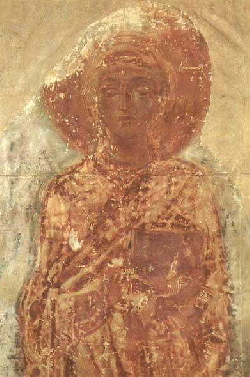
In June 2010, on a wall of the Catacomba di Santa Tecla in Rome, Vatican archaeologists of the Pontifical Commission for Sacred Archaeology, using laser technology to remove layers of clay and lime rind, discovered a frescoed portrait of St Paul the Apostle, "recognizable by his thin face and dark pointed beard…with small eyes and furrowed brow," Biblical Archaeology Review, Jan/Feb 2010, Vol 36 No 1, p. 18: Found in Vatican: Paul’s Portrait which they believe is the oldest image in existence of St Paul, dating from the late fourth century.
Society of Saint Thecla of Iconium
In the Eastern Church, the wide circulation of the Acts of Paul and Thecla is evidence of her veneration. She was called "apostle and protomartyr among women" and "equal to the apostles." She was widely cited as an ascetic rôle model for women. Her society flourished particularly at Seleucia (where she was said to be buried), Iconium (present day Konya), and Nicomedia. The society also appeared at least as early as the fourth century in Western Europe. In Bede’s martyrology, Thecla is celebrated on 23 September, which is her feast day in the Roman Catholic Church. The Eastern Orthodox Churches commemorate her on 24 September.
A local martyr legend of Tecla may have inspired an episode connected to Paul the Apostle. "It is otherwise difficult to account for the very great popularity of the cult of St. Thecla, which spread over East and West, and made her the most famous of virgin martyrs," wrote M.R. James, the editor of this Acta, (James 1924).
Tomb of Thecla, Ma’loula
In Ma’loula, Syria, a Greek Orthodox nunnery of St. Thecla Deir Mar Takla was built near what is said to be her cave tomb, reached by steps in the mountainside, a pilgrimage site with a holy well. The local legend is that the mountain opened miraculously to protect Thecla from her persecutors.
Patronage
Santa Tecla is the patron saint of Tarragona, Spain, where her feast day is the major fiesta of the city and the cathedral is dedicated to her. In Spain, she is sometimes facetiously referred to as the patron saint of computers (tecla means "key" on a keyboard in Spanish and Catalan).
Several cities and towns are named for her:
- Santa Tecla, formerly Nuevo San Salvador, in La Libertad, El Salvador
- Llandegla in North Wales
- Sainte-Thècle, Quebec
- The hamlet of Sainte-Thècle in the commune of Peillon, Alpes-Maritimes, France
- Santa Tecla, a quarter (frazione) of Acireale, Italy
- Santa Tecla de Basto, a quarter (freguesia) of Celorico de Basto, Portugal
- The neighbourhood of Leipzig Thekla in Leipzig, Germany
In the United States there are three Roman Catholic parishes named for Saint Thecla: in Clinton Township, Michigan, in Pembroke, Massachusetts, and in Chicago, Illinois.