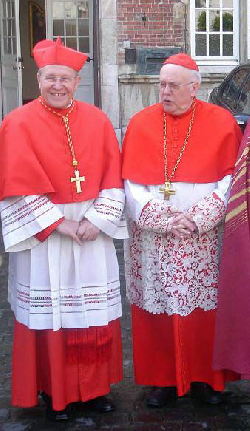
Walter Kasper (born 5 March 1933 in Heidenheim an der Brenz) is a German cardinal of the Roman Catholic Church. He is president Emeritus of the Pontifical Council for Promoting Christian Unity, having served as its president from 2001 to 2010. Kasper speaks German, English and Italian.
Bishop of Rottenburg-Stuttgart
Kasper was named Bishop of Rottenburg-Stuttgart, Germany’s fourth largest Catholic diocese, on 17 April 1989. He was consecrated as a bishop on 17 June that same year by Archbishop Oskar Saier of Freiburg im Breisgau; Bishops Karl Lehmann and Franz Kuhnle served as co-consecrators. In 1993 he and other members of the German episcopate signed a pastoral letter allowing divorced and civilly remarried German Catholics to return to the sacraments, to the disapproval of then Cardinal Ratzinger. In 1994, he was named co-chair of the International Commission for Lutheran-Catholic Dialogue.
Cardinal
He was elevated to the cardinalate by Pope John Paul II in the consistory of 21 February 2001, as Cardinal-Deacon of Ognissanti in Via Appia Nuova.
Upon the death of John Paul II on 2 April 2005, Kasper and all major Vatican officials, in accord with custom, automatically lost their positions during the sede vacante. He was a cardinal elector in the 2005 papal conclave. On the following 21 April, Pope Benedict XVI confirmed him as President of the Pontifical Council for Promoting Christian Unity.
On 21 February 2011, he opted for the order of Cardinal-Priest, with his former diaconal church elevated to the level of cardinalitial title.
Kasper was the oldest cardinal eligible to vote in the Papal conclave of 2013. His 80th birthday was on 5 March 2013, a few days after the resignation of Pope Benedict XVI. His eligibility to serve as an elector ended when that conclave concluded.
Pontifical Council for Promoting Christian Unity
On 3 March 1999, Kasper was appointed President of the Pontifical Council for Promoting Christian Unity – and as such, President of the Commission for Religious Relations with the Jews – and resigned from his post in Rottenburg-Stuttgart.
In February 2011 Cardinal Kasper revealed the that over the course of his career: he was forced to drink vodka while in Moscow for talks with the Russian Orthodox Church. One Orthodox metropolitan, he said, even insisted that he drink vodka for breakfast—though in that case, Kasper said, the vodka was actually fairly good.
Reconciliation with Jews
He was critical of the Congregation for the Doctrine of the Faith document Dominus Iesus (2000), which he believed was an offense to the Jewish people. He was often criticised by conservatives for his role in ecumenism.
In 2003, he wrote a text called Anti-semitism: A wound to be healed for the European Day of Jewish Culture. On 10 July 2004, at the Latin-American Rabbinical Seminary of Buenos Aires, the International Raoul Wallenberg Foundation and the Angelo Roncalli Committee presented Kasper the "Memorial Mural Award" for his lifetime dedication to the causes of understanding and reconciliation between Jews and Catholics.
International Theological Commission
Kasper is a member of the International Theological Commission, an advisory body to the Congregation of the Doctrine of the Faith. He has repeatedly led official delegations of the Vatican on the annual visit to the Ecumenical Patriarchate in Constantinople. In August 2007, he led the Roman Catholic delegation to the funeral ceremony of Patriarch Teoctist of the Romanian Christian Orthodox Church.
Book on the Eucharist
In 2005, Cardinal Kasper wrote a book entitled Sacrament of Unity: The Eucharist and the Church, a reflection on the Eucharist partly inspired by John Paul II’s encyclical Ecclesia de Eucharistia. He insisted on the sacrificial character of the Eucharist, an aspect somewhat overshadowed after the Council.
Book about Jesus Christ
First published in 1976, Cardinal Kasper’s book Jesus The Christ treats Christology in three manners: a contemporary approach, a historical approach and a factual approach. After these three approaches have been exhausted, the Chrisotlogical themes of resurrection, mystery, and priesthood are treated. Ecclesiology is seen as part of Christology in this book because the Church is oriented towards Christ in his person. And Christ did not only say things, but he also did things.Walter Kasper, Jesus the Christ, translated by V. Green, Kent — New Jersey 1976, p.16
Continue reading: part 2 of 2 →

