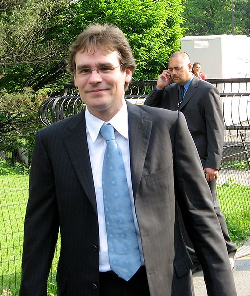
Robert Irwin (born September 12, 1928) is an American Installation artist. He lives and works in San Diego, California.
Exhibitions
Irwin first exhibited paintings at the Los Angeles County Museum of Art in 1957. The exhibit was called “Artists of Los Angeles and Vicinity.” That same year, he participated in the 57th Annual Exhibition of the Whitney Museum of American Art, in New York. That same year, he had his first individual exhibition at the Felix Landau Gallery in Los Angeles.
In 1965, he participated in an exhibition called The Responsive Eye at the Museum of Modern Art in New York and at another called XIII in Bienal de São Paulo, Brazil. In 1966, he exhibited both as an individual and with Kenneth Price at the Los Angeles County Museum of Art and as an individual exhibitor later at The Pace Gallery in New York. In 1969, Irwin exhibited with Doug Wheeler at the Fort Worth Art Center in Fort Worth, Texas. In 1970, he first exhibited scrim “volumes” at the Museum of Modern Art in New York. For the next five years, he exhibited individually at the following locations: the Pace Gallery in New York, the Walker Art Center in Minneapolis, the Minuzo and Ace Galleries in Los Angeles, the Fogg Art Museum on the Harvard Campus in Cambridge, Massachusetts, Wright State University in Dayton, Ohio, the University of California at Santa Barbara, Fort Worth Art Center, and Palomar College in San Marcos, California. He participated in several joint exhibitions: “Transparency, Reflection, Light, Space: Four Artists” at the UCLA Art Gallery in Los Angeles and “Some Recent American Art” at the Museum of Modern Art exhibition for Australia. He also exhibited internationally: “Kompas IV” at Stedelijk Museum in Eindhoven, with other artists, Bell and Wheeler, at the Tate Gallery in London, and Documenta at Kassel in Germany.
In 1993, the Museum of Contemporary Art, Los Angeles mounted the first comprehensive retrospective of Irwin’s career; the exhibition later traveled to the Kölnischer Kunstverein, the Musée d’Art Moderne de la Ville de Paris, and the Museo Nacional Centro de Arte Reina Sofía. Museum of Contemporary Art (MOCA), Los Angeles. In 2008, the Museum of Contemporary Art San Diego presented another comprehensive retrospective spanning fifty years of Irwin’s career.
Irwin has been represented by Pace Gallery, New York, since 1966. Pace Gallery, New York.
Beginnings
Robert Irwin was born in 1928 in Long Beach, California to Robert Irwin and Goldie Anderberg Irwin. After serving in the United States Army from 1946 to 1947, he attended several art institutes: Otis Art Institute in Los Angeles from 1948 to 1950, Jepson Art Institute in 1951, and Chouinard Art Institute in Los Angeles from 1952 to 1954. He spent the next two years living in Europe and North Africa. Between the years 1957-1958, he taught at the Chouinard Art Institute.
Work
In 1977, Robert Irwin wrote the following about himself: “I began as a painter in the middle of nowhere with few questions… My first real question concerned the arbitrariness of my paintings… I used my paintings as a step-by-step process, each new series of works acting in direct response to those questions raised by the previous series. I first questioned the mark as meaning and then even as focus; I then questioned the frame as containment, the edge as the beginning and end of what I see… consider the possibility that nothing ever really transcends its immediate environment… I tried to respond directly to the quality of each situation I was in, not to change it wholesale into a new or ideal environment, but to attend directly to the nature of how it already was. How is it that a space could ever come to be considered empty when it is filled with real and tactile events?” (Robert Irwin, 1977) Robert Irwin’s notion of art derived from a series of experiential perceptions. As an abstract, open-minded thinker, he presented experience first as perception or sense. He concluded that a sense of knowing, or ability to identify, helped to clarify perception. For example,
Continue reading: part 2 of 4 →