Works
Phoolwalon-ki-sair festival
The darbaar shrine of Qutbuddin Bakhtiar Kaki has also been the venue of the annual Phoolwalon-ki-sair (a festival of flower-sellers) in autumn, which has now become an important inter-faith festival of Delhi. bhaans ki aankh. Times of India, Oct 23, 2008.
The festival has its origins in 1812, when Queen Mumtaz Mahal, wife of the Mughal Emperor, Akbar Shah II (r. 1806-1837) made a vow to offer a chadar and flower pankha at the Dargah and a pankha at the Yogmaya Mandir, also at Mehrauli, if her son Mirza Jehangir, who after inviting the wrath of Sir Archibald Seton, the then British Resident of the Red Fort, was exiled to Allahabad, returned safely. And as the legend goes, he did, and so began the tradition. Times of India, Sept 26, 2005. The festival was stopped by the British in 1942, but later revived by the Indian Prime Minister Jawaharlal Nehru in 1961 to bridge the Hindu-Muslim gulf, and inculcate secularist ideals. The Times of India, Sep 28, 2008.
Move to Delhi
In obedience to the desire of his spiritual master, Moinuddin Chishti, Khwaja Bakhtiyar went and started living in the city of Delhi, during the reign of Iltutmish. Attracted by his spiritual prowess and charitable attitude, a large number of people started visiting him daily. He started initiating disciples on the spiritual path as well.
The name Kaki was attributed to him by virtue of a keramat (miracle) that emanated from him in Delhi. Sufi Saints of Delhi. According to it, he asked his wife not to take credit from the local baker despite their extreme poverty. Instead he told her to pick up Kak (a kind of bread) from a corner of their house whenever needed. After this his wife found that Kak miraculously appeared in that corner whenever she required. The baker, in the meantime, had become worried whether the Khwaja had stopped taking credit due to being perchance angry with him. Accordingly, when the baker’s wife asked the reason from the Khwaja’s wife, she told her about the miracle of Kak. Although the Kak stopped appearing due to the revealing of the secret, from that day the people started referring to him as Kaki.
Khwaja Bakhtiyar Kaki, like other Chisti saints, did not formulate any formal doctrine. He used to hold a majlis, a gathering, where he gave his discourses. Directed at the common masses, these contained an emphasis on renunciation, having complete trust in God, treating all human beings as equal and helping them as much as possible, etc. Whatever money was donated to him, he usually spent it on charity the same day.
He was a great believer in helping the needy without heeding the result. When an eminent disciple, Fariduddin Ganjshakar, asked him about the legality of amulets (tawiz) which were controversial as they could lead to theological problems of semi-idolatory in Islam, he replied that the fulfilment of desires belonged to no one; the amulets contained God’s name and His words and could be given to the people.Biographical encyclopaedia of Sufis By N. Hanif. Pg 323
He continued and extended the musical tradition of the Chisti order by participating in sema. It is conjectured that this was with the view that, being in consonance with the role of music in some modes of Hindu worship, it could serve as a basis of contact with the local people and would facilitate mutual adjustments between the two communities. On the 14th of Rabi-ul-Awwal 633 A.H. (27 November 1235 CE) he attended a sema where the poet Ahmad-i-Jam sang the following verses:
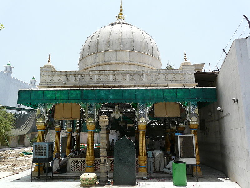
Khwaja Bakhtiyar Kaki was so overcome and enraptured by these verses that he fainted away. He died four days later while still in that state of ecstasy. His dargah (shrine) is near Qutub Minar, in Mehrauli, Delhi.
Left of the Ajmeri Gate of the dargah at Mehrauli, lies Moti Masjid, a small mosque for private prayer built by Mughal emperor Bahadur Shah I in 1709, an imitation of the much larger Moti Masjid built by his father, Aurangzeb, inside the Red Fort of Delhi.Eicher:City Guide – Delhi, Eicher Goodearth Publications. 1998. ISBN 81-900601-2-0. Page 188.
Titles given to Qutbuddin Bakhityar Kaki
- Qutub-ul-Aqtaab
- Malik-ul-Mashaa’ikh
- Rais-us-Saalikin
- Siraj-ul-Auliya
Moti Masjid, [[Mehrauli, built by Bahadur Shah I.]]
Influence
As a well-known saint, Khwaja Bakhtiyar Kaki exercised great sway over the people. He continued the policy of non-involvement with the government of the day. This was the traditional way of saints of the Chisti order in South Asia,Islam in the Indian subcontinent By Annemarie Schimmel Pg 25 as they felt that their linkage with rulers and the government would turn their mind towards worldly matters.
During the lifetime of the Khwaja he was held in great esteem by the Delhi Sultan, Iltutmish. It is contended that the Qutb Minar, the worlds tallest brick minaret, partially built by Iltumish, was named so after him.. The Hindu; Sep 06, 2004; Metro Edition. Retrieved on 15 August 2009. He was also the favorite saint of the Lodhi dynasty which ruled over Delhi from 1451 to 1526.Jafar Sharif/Herclots.Islam in India. Oxford 1921, repr 1972. Pg 143 His importance continues to this day and can be gauged by the following historical fact. When Mahatma Gandhi launched his last fast-unto-death in Delhi in 1948, asking that all communal violence be ended once and for all, he was pressed by leaders of all denominations to end the fast. One of the five conditions that Gandhi put forward to end the fast was that Hindus and Sikhs as an act of atonement should repair the shrine of Khwaja Bakhtiyar Kaki which had been damaged during the communal riots.Abul Kalam Azad. India wins Freedom. Bombay 1959. Pg 219.