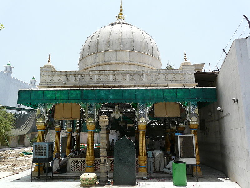
Qutub ul Aqtab Hazrat Khwaja Syed Muhammad Qutbuddin Bakhtiar Kaki () (born 1173-died 1235) was a renowned Muslim Sufi mystic, saint and scholar of the Chishti Order from Delhi, India. He was the disciple and the spiritual successor of Moinuddin Chishti as head of the Chishti order and the person to whom the Qutub Minar, Delhi is dedicated. Before him the Chishti order in India was confined to Ajmer and Nagaur. He played a major role in establishing the order securely in Delhi.Biographical encyclopaedia of Sufis By N. Hanif. Pg 321 His dargah in Mehrauli, the oldest dargah in Delhi, is the venue of his annual Urs. The Urs was held in high regard by many rulers of Delhi like Qutbuddin Aibak, Iltutmish who built a nearby stepwell, Gandhak ki Baoli for him, Sher Shah Suri who built a grand gateway, Bahadur Shah I who built the Moti Masjid mosque nearby and Farrukhsiyar who added a marble screen and a mosque.
His most famous disciple and spiritual successor was Fariduddin Ganjshakar, who in turn became the spiritual master of Delhi’s noted Sufi saint, Nizamuddin Auliya, who himself was the spiritual master of Amir Khusro and Nasiruddin Chirag-e-Delhi.
The influence of Qutubuddin Bakhtiyar Kaki on Sufism in India was immense. As he continued and developed the traditional ideas of universal brotherhood and charity within the Chisti order, a new dimension of Islam started opening up in India which had hitherto not been present. He forms an important part of the Sufi movement which attracted many people to Islam in India in the thirteenth and fourteenth centuries.
Early life
Qutbuddin Bakhtiyar Kaki was born in 569 A.H. (1173 C.E.) in a small town called Aush (alternatively Awash or Ush) in the Fergana Valley (present Osh in southern Kyrgyz Republic, part of historic Transoxania). According to his biography mentioned in, Ain-i-Akbari, written in 16th century by Mughal Emperor Akbar’s vizier, Abu’l-Fazl ibn Mubarak, he was the son of Kamalu’ddin Musa, whom he lost at the young age of a year and a half. Ain-e-Akbari by Abul Faza, English translation, by H. Blochmann and Colonel H. S. Jarrett, 1873–1907. The Asiatic Society of Bengal, Calcutta., Volume III, Saints of India. (Awliyá-i-Hind), Page 363.Islamic Thought and Movements in the Subcontinent, 711-1947, by Syed Moinul Haq. Published by Historical Society, 1979. Page 144.Tabakat-i-Nasiri. A General History of the Muhammadan Dynasties of Asia, Including Hindustan, from A. H. 194 (810 A.D.) to A. H. 658 (1260 A.D.) and the Irruption of the Infidel Mughals into Islam. Translated from Original Persian Manuscripts by Major H. By Abu-‘Umar-i-‘Usman. Published by Adamant Media Corporation. ISBN 1-4021-7110-2. Page 921.
Khwaja Qutbuddin’s original name was Bakhtiyar and later on he was given the title Qutbuddin. He was a descendent of the Prophet Muhammad, descending through Hussain ibn Ali. His mother, who herself was an educated lady, arranged for his education by Shaikh Abu Hifs.
When Moinuddin Chishti passed through Aush during his travels, Khwaja Bakhtiyar took the oath of allegiance at his hands and received the khilafat and Khirqah from him. Thus, he was the first spiritual successor of Moinuddin Chishti.
Gallery
File:Qutbuddin Bakhtiyar Kaki’s tomb, Mehrauli, Delhi.jpg|Qutbuddin Bakhtiyar Kaki’s tomb, Mehrauli File:Courtyard of the Qutbuddin Bakhtiyar Kaki’s dargah complex.jpg|Courtyard of the Qutbuddin Bakhtiyar Kaki’s dargah complex. File:Entrance to grave enclosure within Qutbuddin Bakhtiyar Kaki’s dargah compound.jpg|Entrance to grave enclosure within Qutbuddin Bakhtiyar Kaki’s dargah compound. File:Gandhak ki Baoli, Mehrauli.jpg|Gandhak ki Baoli, a stepwell in Mehrauli, built by Iltutmish for the saint.
Royal grave enclosure
Incidentally, Akbar Shah II is now buried nearby in a marble enclosure, along with other Mughals, Bahadur Shah I and Shah Alam II. An empty grave, also known as Sardgah, of the last Mughal Emperor Bahadur Shah Zafar, can also be found here, as he had willed to be buried next to the famous shrine, as did his previous Mughal predecessors. Unfortunately, he was exiled to Burma where he died. Talks of bringing back his remains here have been raised in the past, from time to time. Metro Plus Delhi, The Hindu, May 21, 2007.
Continue reading: part 2 of 2 →