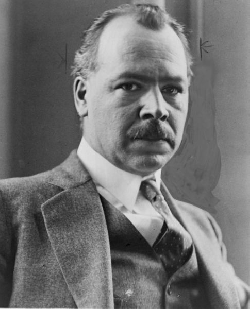
Nikolai Vavilov Part 2
Russian scientist
- Life
- 1887 - January 26, 1943
- Birthday
- January 26
- Length
- 2 parts
From 1924 to 1935 he was the director of the All-Union Institute of Agricultural Sciences at Leningrad. Impressed with the work of Canadian phytopathologist Margaret Newton on wheat stem rust, in 1930 he attempted to lure her to work at the institute, offering a good salary and perks such as a camel caravan for her travel. She declined, but visited the institute in 1933 for three months to train 50 students in her research.
While developing his theory on the centres of origin of cultivated plants, Vavilov organized a series of botanical-agronomic expeditions, collected seeds from every corner of the globe, and created in Leningrad the world's largest collection of plant seeds.. PGR Newsletter 124. Bioversity International. This seedbank was diligently preserved even throughout the 28-month Siege of Leningrad, despite starvation; at least one of Nikolai's assistants starved to death surrounded by edible seeds.
"Hitler's army had already closed in on St. Petersburg (then Leningrad)—a desperate city that had lost more than 700,000 people to hunger and disease. The Soviets had ordered the evacuation of art from the Hermitage, convinced that Hitler had his sights set on the museum. They had done nothing, however, to safeguard the 250,000 accessions of seeds, roots, and fruits stored in the world's largest seed bank. So a group of scientists at the Vavilov Institute boxed up a cross section of seeds, moved them to the basement, and took shifts protecting them. Historical documents later revealed that Adolf Hitler had, in fact, established a commando unit to seize the seed bank, perhaps hoping to one day control the world's food supply. Although suffering from hunger, the seeds' caretakers refused to eat what they saw as their country's future. Indeed, by the end of the siege in the spring of 1944, nine of the institute's self-appointed seed guardians had died of starvation."
Vavilov also formulated the law of homologous series in variation.. He was a member of the USSR Central Executive Committee, President of All-Union Geographical Society and a recipient of the Lenin Prize. During most of his career Vavilov was assisted by his deputy Georgy Balabajev.
Botanist Nikolai Vavilov's mugshot, taken at the time of his arrest.
Vavilov repeatedly criticised the non-Mendelian concepts of Trofim Lysenko, who won the support of Joseph Stalin. As a result, Vavilov was arrested on August 6, 1940, while on an expedition to Ukraine. He was sentenced to death in July 1941, which was commuted to twenty years' imprisonment in 1942; he died in prison in 1943. The verdict was posthumously set aside at a hearing of the Military Collegium of the Supreme Court of the Soviet Union on August 20, 1955, undertaken as part of a de-Stalinization effort to review Stalin-era death sentences. By the 1960s his reputation was publicly rehabilitated and he began to be hailed as a hero of Soviet science.
According to Cohen, by 1940, Vavilov had accumulated a collection of 200,000 plant seeds from the Soviet Union and from abroad. The collection was seized by a German SS squad in 1943 and partially transferred to the SS Institute for Plant Genetics, which had been established at the Lannach Castle near Graz, Austria.. PGR Newsletter 129. Bioversity International. However, the Germans could only take samples stored within the territories occupied by the German armies, mainly in Ukraine and Crimea. The main gene bank in Leningrad was not affected. The leader of the German squad was Heinz Brücher, an SS officer who was also a plant genetics expert.
Today, the N.I. Vavilov Institute of Plant Industry in St. Petersburg still maintains one of the world's largest collections of plant genetic material. at www.vir.nw.ru The Institute began as the Bureau of Applied Botany in 1894, and was reorganized in 1924 into the All-Union Research Institute of Applied Botany and New Crops, and in 1930 into the Research Institute of Plant Industry. Vavilov was the head of the institute from 1921 to 1940. In 1968 the institute was renamed after him in time for its 75th anniversary.
A minor planet, 2862 Vavilov, discovered in 1977 by Soviet astronomer Nikolai Stepanovich Chernykh is named after him and his brother Sergey Ivanovich Vavilov. The crater Vavilov on the Far side of the Moon is also named after him and his brother. The story of the researchers at the Vavilov Institute during the Siege of Leningrad was fictionalized by novelist Elise Blackwell in her 2003 novel Hunger. That novel was the inspiration for the Decemberists' song "When The War Came" in the 2006 album The Crane Wife, which also depicts the Institute during the siege and mentions Vavilov by name.