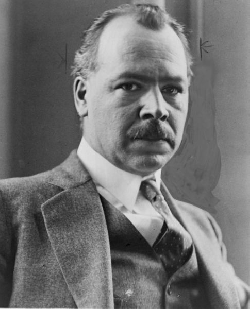
Nikolai Vavilov
Russian scientist
- Life
- 1887 - January 26, 1943
- Birthday
- January 26
- Length
- 2 parts
Nikolai Ivanovich Vavilov ForMemRS () (November 13 (November 25) 1887 – January 26, 1943) was a prominent Russian and Soviet botanist and geneticist best known for having identified the centres of origin of cultivated plants. He devoted his life to the study and improvement of wheat, corn, and other cereal crops that sustain the global population.
Timeline
- 1887 - born November 25, in Moscow.
- 1911 - graduated from the Moscow Agricultural Institute.
- 1917-1921 - professor of the agronomy department of the Saratov University.
- 1919 - theory of the immunity for plants.
- 1920 - formulation of the law of homology series in genetical mutability.
- mid 1920s - Vavilov befriends the young peasant Trofim Lysenko and begins taking him to scientific meetings
- 1921(–1940) - chairman of the applied botanics and selection section in Petrograd, which in 1924 was reorganized into the All-Union Institute of Applied Botanics and New Crops and in 1930, into the All-Union Institute of Plant Cultivation, with Vavilov being director until August, 1940.
- 1924 - Vladimir Lenin dies and is replaced by Josef Stalin - a turning point in Vavilov's life
- 1926 - Lenin Award.
- 1930–1940 - head of the genetics laboratory in Moscow, later reorganized into the Institute of Genetics of the USSR Academy of Sciences.
- 1931–1940 - President of the All-Union Geographical Society.
- Late 1930s - Lysenko, who has conceived a hatred for genetics is put in charge of all of Soviet agriculture
- 1940 - arrested for allegedly wrecking Soviet agriculture; delivered more than a hundred hours of lectures on science while in prison
- 1943 - died imprisoned and suffering from dystrophia (faulty nutrition of muscles, leading to paralysis), in the Saratov prison.
The USSR Academy of Sciences established the Vavilov Award (1965) and the Vavilov Medal (1968).
Works
- Земледельческий Афганистан. (1929) (Agricultural Afghanistan)
- Селекция как наука. (1934) (Selection as science)
- Закон гомологических рядов в наследственной изменчивости. (1935) (The law of homology series in genetical mutability)
- Учение о происхождении культурных растений после Дарвина. (1940) (The theory of origins of cultivated plants after Darwin)
Works in English
- The Origin, Variation, Immunity and Breeding of Cultivated Plants (translated by K. Starr Chester). 1951. Chronica Botanica 13:1–366
- Origin and Geography of Cultivated Plants (translated by Doris Löve). 1992. Cambridge University Press, Cambridge. ISBN 0-521-40427-4
- Five Continents (translated by Doris Löve). 1997. IPGRI, Rome; VIR, St. Petersburg ISBN 92-9043-302-7
- Vavilov and his Institute. A history of the world collection of plant genetic resources in Russia, Loskutov, Igor G. 1999. International Plant Genetic Resources Institute, Rome, Italy. ISBN 92-9043-412-0
- The Murder of Nikolai Vavilov: The Story of Stalin's Persecution of One of the Greatest Scientists of the Twentieth Century, by Peter Pringle. 2008. Simon & Schuster. ISBN 978-0-7432-6498-3
Biography
Vavilov was born into a merchant family in Moscow, the older brother of renowned physicist Sergey Ivanovich Vavilov. "The son of a Moscow merchant who'd grown up in a poor rural village plagued by recurring crop failures and food rationing, Vavilov was obsessed from an early age with ending famine in both his native Russia and the world."Siebert, Charles. 2011. “Food Ark.” National Geographic. Volume 220 (1), July 2011. Pages 122-126. He graduated from the Moscow Agricultural Institute in 1910 with a dissertation on snails as pests. From 1911 to 1912, he worked at the Bureau for Applied Botany and at the Bureau of Mycology and Phytopathology. From 1913 to 1914 he travelled in Europe and studied plant immunity, in collaboration with the British biologist William Bateson, who helped establish the science of genetics.
Continue reading: part 2 of 2 →