Milan Rastislav Štefánik
Slovak scientist and politician
- Life
- July 21, 1880 – May 4, 1919
- Birthday
- July 21
- Field
- Science - Other
- Length
- 2 parts
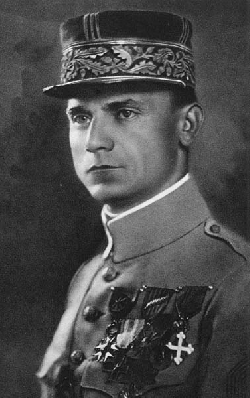
Štefánik’s statue on [[Prague’s Petřín]] Identical statue atop war memorial in Paulhan, France Milan Rastislav Štefánik ( ( July 21, 1880 in Košariská (Kosaras), Kingdom of Hungary – May 4, 1919 in Ivanka pri Dunaji, Czechoslovakia) was a Slovak politician, diplomat, and astronomer. During World War I, he served as a General in the French Army and, at the same time, as the Czechoslovak Minister of War. As one of the leading members of the Czechoslovak National Council (i.e. resistance government), he contributed decisively to the cause of Czechoslovak sovereignty. (The status of Czech- and Slovak-populated territories, among others, was in question until shortly before the disintegration of Austria-Hungary in 1918.)
Štefánik’s personal motto was: To Believe, To Love and To Work (Veriť, milovať, pracovať).
France, Tahiti and other countries
In 1904, he went to Paris to find a job in astronomy with the recommendation of a Czech professor who was known in Paris. Initially, he had no money and no command of French, but was nevertheless able to obtain a job at the famous Observatoire de Paris-Meudon, whose director, Pierre Janssen (one of the co-founders of astrophysics), saw Štefánik’s talent. Štefánik owed to Janssen and Camille Flammarion his social, political and scientific career. The observatory was the most important centre for astronomy at this time which meant a huge prestige in his job.
Between 20 June and 4 July in 1905, Štefánik climbed Mont Blanc (later he climbed it several times) in order to observe the Moon and Mars. Then he took part in an official French expedition which observed and recorded a whole eclipse of the Sun in Alcossebre in Spain. Thereby he established his own recognition in the French scientific society. He worked with Gaston Millochau who was a member of the Académie Française, so some of its members read from his work. –His studies and the results of his observations were published in reports to the Académie Française and he received several awards for them – Later he was invited to an international astronomer conference in Oxford which was interested in research of the Sun. Between 1906 and 1908, he was co-director of Mont Blanc observatories company.
At the end of 1907, however, Pierre Janssen died and Štefánik had to change his job. Since 1908, he had been charged by the French authorities with astronomic and meteorological observations (mainly observations of sun eclipses) and political tasks in various countries all over the world including (Algeria, Morocco, Turkistan, Russia, India, the USA, Panama, Brazil, Ecuador, Australia, New Zealand, Tahiti, Fiji and Tonga). In Tahiti, he also built an observatory and a network of meteorological stations (rumor has it that he spent much of his time in the Pacific spying on German positions). Between these voyages he regularly returned home to Košariská (the last time in 1913 for his father’s funeral). When he was in South America (especially in the Galapagos Islands in Ecuador), he had an opportunity to show his diplomatic skills for the first time.
Štefánik dealt with astrophysics, solar physics and became well known for his spectral analysis of the sun’s corona. He was involved in perfecting spectrography and has been considered a predecessor of Bernard Lyot. He also attempted to construct a machine for color photography and cinematography and had his design patented in 1911.
In addition to his scientific missions overseas, he also performed diplomatic tasks. He established contacts and friendships with leading scientific, artistic, political, diplomatic and business personalities. He participated in the establishment of business enterprises in France and other countries. His friends were Henri Poincaré physicist, count Eugéne Aymar de la Baume, Joseph Vallot (who was the richest man in France), Gustave Eiffel architect, prince Roland Bonaparte, Camille Chautemps Prime-Minister, a French entrepreneur called Devousoud from Chamonix, Simon Newcomb American astronomer and admiral, David Jayne Hill American diplomat. In 1912, he received French citizenship, recognition and access to the French elite. On October 20, 1917, he was made a Grand Officier of the Legion of Honour. At the same time, however, he had some personal problems and a serious stomach illness (which did not get better even after a medical operation). Moreover, World War I started in Europe.
Continue reading: part 2 of 2 →


