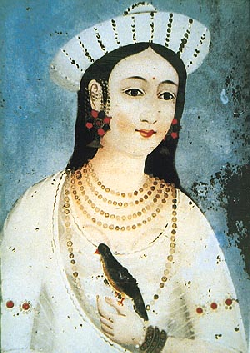
In April 1740, while Baji Rao was inspecting his lands at Khargon, he suddenly became ill and died. Baji Rao’s wife Kashibai, his brother Chimnaji Appa, his son Balaji (Nanasaheb), and Mastani came to Khargon. Bajirao’s mortal remains were consigned to flames on 28 April 1740, at Raver Khed on the banks of the Narmada River. Mastani died at Pabal Village near Pune, soon afterwards.
Cause of deathAccording to popular folklore, Mastani committed suicide after hearing about Bajirao’s death, by drinking poison from a ring which she was wearing. Others say that she jumped into the funeral pyre of her husband and committed sati. No documentation is available to confirm the actual cause. However it is accepted that she did not live long after Bajirao’s demise and died in 1740.
Mastani’s graveHer grave is in Pabal. It is called Mastani’s Samadhi and is maintained by Mr. Inamdar.
Kashibai took Mastani’s six-year-old son Shamsher Bahadur (also named as Krushnarao) into her household and raised him as one of her own.
Mastani in popular culture
- The story of Baji Rao and Mastani was made into a motion picture, Mastani, directed by Dhirubhai Desai, and released in 1955.
- Sanjay Leela Bhansali announced in 2003 that he wanted to make a film titled "Bajirao Mastani", but he has indefinitely postponed the project. Towards the end of 2011, there are unconfirmed reports about Sanjay approaching Aishwarya Rai Bachchan for the role of Mastani and Salman Khan for the role of Bajirao but didn’t materialise.
- A Marathi serial, "Rau", was produced in the 1990s, based on a Marathi book of the same name by historical novelist N. S. Inamdar about the life story of Baji Rao and Mastani.
- Currently a daily serial is being broadcast on ETV Marathi by the name, Shrimant Peshwa Bajirao Mastani.
Local lore in Pune believes that while in Pune, Mastani used to go for her bath to a lake (created by Bajirao specially for Mastani on Pune – Saswad Road) with her entourage. That lake still exists there.


