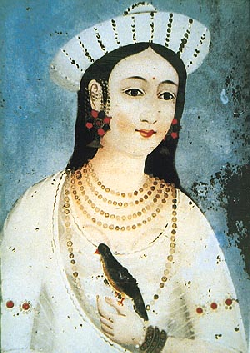
Mastani (died 1740) was the wife of Peshwa Baji Rao I (1699–1740), an Indian general and prime minister to the fourth Maratha Chhatrapati (Emperor) Shahuji. She is said to have been a beautiful and brave woman.
Biography
Peshwa Baji Rao I Mastani was a daughter of a Hindu, Maharaja Chhatrasal (1649–1731), of Bundelkhand province, accessed 3 March 2008 and was borne by his Persian-Muslim wife. When a Mughal chief from Allahabad, Mohammad Khan Bangash, invaded Chhattrasal’s kingdom during 1727-28 and imprisoned him and his family, Chhattrasal sent a secret message, seeking help, to Baji Rao, who happened to be on a military campaign in the vicinity of Bundelkhand. Bajirao came to the rescue of Chhatrasal, defeated Bangash’s army, and restored Chhatrasal to his throne. In gratitude, Chattrasal gave Bajirao his daughter Mastani, and also a third of his kingdom, including Jhansi, Sagar and Kalpi. He gave 33 lakh gold coins to Bajirao. He also gifted a diamond mine to Bajirao in marriage of Mastani and Bajirao.
However sources vary on this context. According to the second view she was daughter of Nizam of Hyderabad, Marathas who had defeated Nizam in 1734 was advised by his wife to marry his daughter to Peshwa to foster friendly relations with the Marathas who had become the most dominant power in India and in the Indian Subcontinent.http://books.google.co.in/books?id=UkDi6rVbckoC&pg=PA27&dq=mastani+daughter+of+nizam&hl=en&ei=iw-LTtupB8yrrAe498H0AQ&sa=X&oi=book_result&ct=result&resnum=1&ved=0CC0Q6AEwAA
The third origin of Mastani is said to be that she was a dancer in Nizam Court and after Nizam accepted the defeated during the meeting of Peshwa with Nizam he fell in love with Mastani and married her which was condemned by Brahmins and other Hindus as Baji Rao was an upper caste Brahmin.
However the most accepted version is that she was daughter of Chatrasal with his Persian Moslem wife. Mastani is often referred to as Bajirao’s concubine or mistress. However, she was his lawfully wedded wife.
Mastani gave the Peshwa son, on whom their father bestowed the jagir of Banda. The son fought on the side of the Marathas in the third Battle of Panipat in a.d. 1761 between Ahmed Shah Abdali and the Marathas and he is said to have been killed in the battle.
Mastani was a skilled horse-rider, and she accompanied Baji Rao on his military campaigns. According to legends, she was skilled in spear-throwing and swordsmanship. She was also a talented dancer and singer. Both Mastani and Baji Rao’s wife, Kashibai, bore sons to Baji Rao within a few months of each other. Kashibai’s child died at an early age. Mastani’s child was named Shamsher Bahadur.
However, Baji Rao’s love for his half-Moslem wife Mastani, and neglect of Kashibai angered his mother, Radhabai. In deference to Radhabai, Baji Rao’s brother, Chimnaji Appa, tried to send Mastani into exile. Baji Rao’s son, Balaji, also tried to coerce Mastani into leaving his father, but she refused. Enraged by her growing influence on Baji Rao, and Baji Rao’s neglect of Kashibai, Balaji had Mastani placed under house arrest for a time, while Baji Rao was on military campaign.
Mastani lived for some time with Baji Rao at his palace of Shaniwar Wada in the city of Pune. The palace’s north-east corner held Mastani Mahal and had its own external doorway called Mastani darwaza. Because of his family’s intolerance of Mastani, Baji Rao later built a separate residence for Mastani at Kothrud in 1734, some distance away from Shaniwar Wada. The site still exists at the Mrutyunjay temple on Karve road. The palace at Kothrud was dismantled and parts of this are displayed at a special section of Raja Kelkar Museum. accessed 3 March 2008 Court records (Bakhars) during Bajirao’s regime specifically never included any reference to her. Historians have determined that the paintings of Mastani in both Raja Kelkar museum and Wai museum are not authentic.


