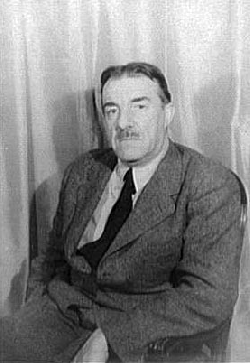
Fernand Léger
French painter
- Life
- February 4, 1881 - August 17, 1955
- Birthday
- February 4
- Length
- 3 parts
Joseph Fernand Henri Léger ( February 4, 1881 – August 17, 1955) was a French painter, sculptor, and filmmaker. In his early works he created a personal form of cubism which he gradually modified into a more figurative, populist style. His boldly simplified treatment of modern subject matter has caused him to be regarded as a forerunner of pop art.
Legacy
Léger wrote in 1945 that "the object in modern painting must become the main character and overthrow the subject. If, in turn, the human form becomes an object, it can considerably liberate possibilities for the modern artist." He elaborated on this idea in his 1949 essay, "How I Conceive the Human Figure", where he wrote that "abstract art came as a complete revelation, and then we were able to consider the human figure as a plastic value, not as a sentimental value. That is why the human figure has remained willfully inexpressive throughout the evolution of my work".Néret 1993, p. 98. As the first painter to take as his idiom the imagery of the machine age, and to make the objects of consumer society the subjects of his paintings, Léger has been called a progenitor of Pop art.Buck 1982, p. 42.
He was active as a teacher for many years. Among his pupils were Nadir Afonso, Robert Colescott, Paul Georges, Charlotte Gilbertson, Hananiah Harari, Asger Jorn, Michael Loew, Beverly Pepper, Victor Reinganum, Marcel Mouly, George L. K. Morris, René Margotton, Erik Olson, Saloua Raouda Choucair and Charlotte Wankel.
In 1952, a pair of Léger murals was installed in the General Assembly Hall of the United Nations headquarters in New York, New York. Retrieved October 13, 2010
In 1960, the Musée Fernand Léger was opened in Biot, Alpes-Maritimes,France.
In November 2003, his painting, La femme en rouge et vert sold for $22,407,500 United States dollars. Sales prices of his sculptures have exceeded 8 million dollars.
In August 2008, one of Léger's paintings owned by Wellesley College's Davis Museum, Mother and Child, was reported missing. It is believed to have disappeared some time between April 9, 2007 and November 19, 2007. A $100,000 reward is being offered for information that leads to the safe return of the painting.
Biography
Léger was born in Argentan, Orne, Lower Normandy, where his father raised cattle. Fernand Léger initially trained as an architect from 1897–1899, before moving in 1900 to Paris, where he supported himself as an architectural draftsman. After military service in Versailles, Yvelines, in 1902–1903, he enrolled at the School of Decorative Arts after his application to the École des Beaux-Arts was rejected. He nevertheless attended the Beaux-Arts as a non-enrolled student, spending what he described as "three empty and useless years" studying with Gérôme and others, while also studying at the Académie Julian.Néret 1993, p. 35. He began to work seriously as a painter only at the age of 25. At this point his work showed the influence of impressionism, as seen in Le Jardin de ma mère (My Mother's Garden) of 1905, one of the few paintings from this period that he did not later destroy. A new emphasis on drawing and geometry appeared in Léger's work after he saw the Cézanne retrospective at the Salon d'Automne in 1907.Néret 1993, pp. 35–38.
1909–1914
In 1909 he moved to Montparnasse and met such leaders of the avant-garde as Archipenko, Lipchitz, Chagall, Joseph Csaky and Robert Delaunay. His major painting of this period is Nudes in the Forest (1909–10), in which Léger displays a personal form of Cubism—his critics called it "Tubism" for its emphasis on cylindrical forms—that made no use of the technique pioneered by Braque and Picasso.Néret 1993, pp. 102 and 242.
In 1910 he exhibited at the Salon d'Automne in the same room (salle VIII) with Jean Metzinger and Henri Le Fauconnier. In 1911 the hanging committee of the Salon des Indépendants placed together the painters that would soon be identified as 'Cubists'. Metzinger, Gleizes, Le Fauconnier, Delaunay and Léger were responsible for revealing Cubism to the general public for the first time as an organized group.
Continue reading: part 2 of 3 →
