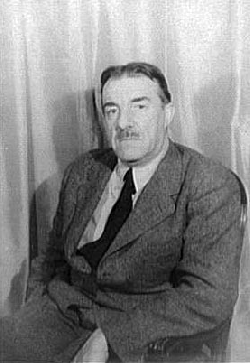
Fernand Léger Part 2
French painter
- Life
- February 4, 1881 - August 17, 1955
- Birthday
- February 4
- Length
- 3 parts
The following year he again exhibited at the Salon d'Automne and Indépendants with the Cubists, and joined with several artists, including Henri Le Fauconnier, Jean Metzinger, Albert Gleizes, Francis Picabia and the Duchamp brothers, Jacques Villon, Raymond Duchamp-Villon and Marcel Duchamp to form the Puteaux Group—also called the Section d'Or (The Golden Section).
Léger's paintings, from then until 1914, became increasingly abstract. Their tubular, conical, and cubed forms are laconically rendered in rough patches of primary colors plus green, black and white, as seen in the series of paintings with the title Contrasting Forms.
1914–1920
The City, 1919, oil on canvas, [[The Museum of Modern Art, New York]]
Léger's experiences in World War I had a significant effect on his work. Mobilized in August 1914 for service in the French Army, he spent two years at the front in Argonne.Néret 1993, p. 242. He produced many sketches of artillery pieces, airplanes, and fellow soldiers while in the trenches, and painted Soldier with a Pipe (1916) while on furlough. In September 1916 he almost died after a mustard gas attack by the German troops at Verdun. During a period of convalescence in Villepinte he painted The Card Players (1917), a canvas whose robot-like, monstrous figures reflect the ambivalence of his experience of war. As he explained:...I was stunned by the sight of the breech of a 75 millimeter in the sunlight. It was the magic of light on the white metal. That's all it took for me to forget the abstract art of 1912–1913. The crudeness, variety, humor, and downright perfection of certain men around me, their precise sense of utilitarian reality and its application in the midst of the life-and-death drama we were in ... made me want to paint in slang with all its color and mobility.Néret 1993, p. 66. This work marked the beginning of his "mechanical period", during which the figures and objects he painted were characterized by sleekly rendered tubular and machine-like forms. Starting in 1918, he also produced the first paintings in the Disk series, in which disks suggestive of traffic lights figure prominently.Buck 1982, p. 141. In December 1919 he married Jeanne-Augustine Lohy, and in 1920 he met Le Corbusier, who would remain a lifelong friend.
1920s
Still Life with a Beer Mug, 1921, oil on canvas, the [[Tate]] The "mechanical" works Léger painted in the 1920s, in their formal clarity as well as in their subject matter—the mother and child, the female nude, figures in an ordered landscape—are typical of the postwar "return to order" in the arts, and link him to the tradition of French figurative painting represented by Poussin and Corot.Cowling and Mundy 1990, pp. 136–138. In his paysages animés (animated landscapes) of 1921, figures and animals exist harmoniously in landscapes made up of streamlined forms. The frontal compositions, firm contours, and smoothly blended colors of these paintings frequently recall the works of Henri Rousseau, an artist Léger greatly admired and whom he had met in 1909.
They also share traits with the work of Le Corbusier and Amédée Ozenfant who together had founded Purism, a style intended as a rational, mathematically based corrective to the impulsiveness of cubism. Combining the classical with the modern, Léger's Nude on a Red Background (1927) depicts a monumental, expressionless woman, machinelike in form and color. His still life compositions from this period are dominated by stable, interlocking rectangular formations in vertical and horizontal orientation. The Siphon of 1924, a still life based on an advertisement in the popular press for the aperitif Campari, represents the high-water mark of the Purist aesthetic in Léger's work.Eliel 2001, p. 37. Its balanced composition and fluted shapes suggestive of classical columns are brought together with a quasi-cinematic close-up of a hand holding a bottle.
As an enthusiast of the modern, Léger was greatly attracted to cinema, and for a time he considered giving up painting for filmmaking.Néret 1993, p. 119. In 1923–24 he designed the set for the laboratory scene in Marcel L'Herbier's L'Inhumaine (The Inhuman One). In 1924, in collaboration with Dudley Murphy, George Antheil, and Man Ray, Léger produced and directed the iconic and Futurism-influenced film, Ballet Mécanique (Mechanical Ballet). Neither abstract nor narrative, it is a series of images of a woman's lips and teeth, close-up shots of ordinary objects, and repeated images of human activities and machines in rhythmic movement.Eliel 2001, p. 44.
Continue reading: part 3 of 3 →
