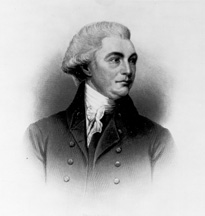
William Bingham
American Continental congressman and senator for Pennsylvania
- Life
- March 8, 1752 - February 7, 1804
- Birthday
- March 8
- Length
- 2 parts
William Bingham (April 8, 1752February 6, 1804) was an American statesman from Philadelphia, Pennsylvania. He was a delegate for Pennsylvania to the Continental Congress from 1786 to 1788 and served in the United States Senate from 1795 to 1801.
Family
He married Anne Willing, daughter of Thomas Willing, President of the First Bank of the United States, and they had two daughters and a son.
- Ann Louisa Bingham. In 1798, she married Alexander Baring, 1st Baron Ashburton. They were the parents of nine children.
- Maria Matilda Bingham (1783-1849). At the age of 15, she was briefly married to a French aristocrat, Jacques Alexandre, Comte de Tilly. Afterwards she married her sister's brother-in-law, Henry Baring. They were the parents of five children.
- William Bingham (1800-1852). In 1822, he married Marie-Charlotte Chartier de Lotbiniere (1805-1866), Seigneuresse de Rigaud. She was the second of the three daughters and heiresses of Michel-Eustache-Gaspard-Alain Chartier de Lotbinière, by his second wife Mary, daughter of Captain John Munro. They lived in Montreal, Paris and London; and were the parents of six children.
Although his wife and two daughters factored prominently in the social affairs of American politics, Bingham's wife Ann died while his only son William was one year old. William Sr. left William Jr. to grow up in America with his grandfather Thomas Willing.
Bingham died on February 6, 1804 in Bath,Alberts, page 427. England and is interred in Bath Abbey. His estate was not settled until 1964.Associated Press. "Heirs of 1804 Trust to Divide $840,000." New York Times. November 15, 1964. Page One.
Early life
William Bingham was born on 8 April 1752 in Philadelphia.G. E. Cokayne, with Vicary Gibbs, H.A. Doubleday, Geoffrey H. White, Duncan Warrand and Lord Howard de Walden, editors. The Complete Peerage of England, Scotland, Ireland, Great Britain and the United Kingdom, Extant, Extinct or Dormant, new ed., 13 volumes in 14 (1910-1959; reprint in 6 volumes, Gloucester, U.K.: Alan Sutton Publishing, 2000), volume I, page 277. He graduated from the College of Philadelphia (now the University of Pennsylvania) in 1768.
Politics
During the provisional government of the United States at Philadelphia, he wrote the by-laws for the national Bank of North America. He saw the national debt as beneficial in that it attracted interest into the affairs of the government. During the first presidency, Treasurer Alexander Hamilton sought Bingham as his mentor in managing taxes, tariffs, and in constructing a national bank.Alberts, page 195.
Speaker of Pennsylvania House
In America, he represented Pennsylvania as a delegate to the Continental Congress from 1786 to 1788. In 1790 and 1791 he was elected to the Pennsylvania House of Representatives, serving as its first speaker in 1791. He oversaw development of the land during a fledging period of America as a member of the Society of Roads and Inland Navigation, where he worked closely with Albert Gallatin of western Pennsylvania.Alberts, page 239. He later served in the Pennsylvania State Senate from 1793 through 1794. He built roads and a bridge from Philadelphia to Lancaster, Pennsylvania called the Lancaster Pike.
American Senator
By 1795, he was elected to the United States Senate where he served as a Federalist and Nationalist while it was originally at Philadelphia, but he left for England in 1801 when his wife had taken ill. He was an active supporter of John Adams and when Adams was elected President, Bingham served as the Senate's President pro tem in the Fourth Congress. He was criticized by Jeffersonian politicians for "extravagance, ostentation and dissipation". In 1813, nearly ten years after his death, John Quincy Adams said that the Presidency, the Capital and the Country had been governed by Bingham and his family connections.
The several Bingham estates were renown for hosting many prominent aristocrats from Europe as well as Federalist meetings. At the Bingham estate, Federalists agreed to hold preliminary votings before propositions were brought before Congress publicly, thus creating unanimity among party lines.Alberts, page 337.
Continue reading: part 2 of 2 →
