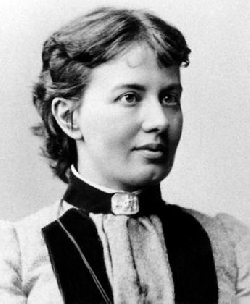
Sofia Kovalevskaya
First major Russian female mathematician
- Life
- January 15, 1850 - February 10, 1891
- Birthday
- January 15
- Length
- 3 parts
Sofia Vasilyevna Kovalevskaya () (3 January (15 January) 1850 – 29 January (10 February) 1891) was the first major Russian female mathematician, responsible for important original contributions to analysis, differential equations and mechanics, and the first woman appointed to a full professorship in Northern Europe. She was also one of the first women to work for a scientific journal as an editor.
There are some alternative transliterations of her name. She herself used Sophie Kowalevski (or occasionally Kowalevsky), for her academic publications. After moving to Sweden, she called herself Sonya.
Selected publications
- (The surname given in the paper is "von Kowalevsky".)
In film
Sofia Kovalevskaya has been the subject of three film and TV biographies.
- Sofya Kovalevskaya (1956) directed by Iosef Shapiro, starring Yelena Yunger, Lev Kosolov and Tatyana Sezenyevskaya.
- Berget På Månens Baksida ("A Hill on the Dark Side of the Moon") (1983) directed by Lennart Hjulström, starring Gunilla Nyroos as Sofja Kovalewsky and Bibi Andersson as Anne Charlotte Edgren-Leffler, Duchess of Cajanello, and sister to Gösta Mittag-Leffler.
- Sofya Kovalevskaya (1985 TV) directed by Azerbaijani director Ayan Shakhmaliyeva, starring Yelena Safonova as Sofia.
Last years in Germany and Sweden
In the early 1880s, Sofia and her husband Vladimir developed financial problems. Sofia wanted to be a lecturer at the university; however, she was not allowed to because she was a woman, even though she had the same amount of knowledge in mathematics as men. Sofia had even volunteered to provide free lectures and she was still denied the right. Soon after, Vladimir started business management and Sofia became his assistant. They built houses as well as fountains to become financially stable again for a short period of time. In 1879, the price for mortgages became higher than the amount of money they made. They lost all their money again and became bankrupt. Shortly after, Vladimir got a job offer and Sofia helped neighbours to electrify street lights. Vladimir and Sofia quickly established themselves again financially.
The Kovalevskys returned to Russia, but failed to secure professorships because of their radical political beliefs. Discouraged, they went back to Germany. Vladimir, who had always suffered severe mood swings, became more unstable so they spent most of their time apart. Then, for some unknown reason, they decided to spend several years together as an actual married couple. During this time their daughter, Sofia (called "Fufa"), was born. After a year devoted to raising her daughter, Kovalevskaya put Fufa under the care of her older sister, resumed her work in mathematics and left Vladimir for what would be the last time. In 1883, faced with worsening mood swings and the possibility of being prosecuted for his role in a stock swindle, Vladimir committed suicide.
That year, with the help of the mathematician Gösta Mittag-Leffler, whom she had known as a fellow student of Weierstrass', Kovalevskaya was able to secure a position as a privat-docent at Stockholm University in Sweden. Kovalevskaya met Mittag-Leffler through his sister, actress, novelist, and playwright Anne-Charlotte Edgren-Leffler. The two women had an intimate "romantic friendship" that lasted until Kovalevskaya's death.McFadden, Margaret. Golden Cables of Sympathy: The Transatlantic Sources of Nineteenth Century Feminism. University Press of Kentucky, 1999.
Sofia Kovalevskaya was inspired by her father's old calculus sheets. The following year (1884) she was appointed to a five year position as "Professor Extraordinarius" (Professor without Chair) and became the editor of Acta Mathematica. In 1888 she won the Prix Bordin of the French Academy of Science, for her work on the question: "Mémoire sur un cas particulier du problème de le rotation d'un corps pesant autour d'un point fixe, où l'intégration s'effectue à l'aide des fonctions ultraelliptiques du temps". Her submission included the celebrated discovery of what is now known as the "Kovalevsky top", which was subsequently shown (by Liouville) to be the only other case of rigid body motion, beside the tops of Euler and Lagrange, that is "completely integrable".
Continue reading: part 2 of 3 →