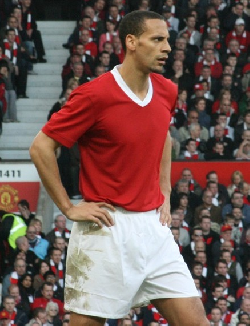
Rio Ferdinand Part 7
English footballer
- Life
- 7 November 1978
- Birthday
- November 7
- Length
- 8 parts
On 25 March 2008 it was announced that Ferdinand would wear the captain's armband for Fabio Capello's second game in charge of the national team, ahead of John Terry, Steven Gerrard or David Beckham, who some believed would be named captain to mark his 100th cap for his country. An FA statement suggested that the decision to name Ferdinand as captain was part of Capello's plans of rotating the captaincy before naming an official captain for September's World Cup qualifiers. On 19 August, however, Ferdinand lost out to Terry in retaining the captain's armband but was named vice-captain by Fabio Capello.
A mistake in the match between England and Ukraine in Dnipro on 10 October 2009 which led to the sending off of Robert Green led some to question his inclusion in the squad. A lack of match practice for his club and a series of errors such as he suffered in his early days as a footballer led to criticism of his inclusion from several corners.McNulty, Phil (10 October 2009) . Bbc.co.uk. Retrieved on 13 May 2013.
On 5 February 2010, Ferdinand replaced John Terry as captain of England.
Although back and groin injury problems forced him to miss much of the 2009–10 domestic season, Ferdinand was selected to captain England at the 2010 World Cup. However, he suffered a knee ligament injury during the team's first training session in South Africa on 4 June and was subsequently ruled out of the tournament. On 19 March 2011, ahead of England's Euro 2012 qualifier against Wales, Capello announced that John Terry was to be re-instated as permanent England captain and that Ferdinand would return to his role of vice-captain.
Ferdinand was left out of Roy Hodgson's squad for Euro 2012, leading to strong speculation this was to avoid potential conflict with John Terry, who was included in the squad, due to Terry's upcoming trial for racially abusing Ferdinand's brother Anton. Further controversy arose when after Gary Cahill was ruled out of the tournament 22-year-old Martin Kelly with just two minutes of international football was called up as a replacement instead of Ferdinand. This lead to Ferdinand's representative Jamie Moralee accusing Hodgson of showing a "lack of respect".
On 3 October 2012, The Daily Mirror reported that Roy Hodgson had revealed to fellow passengers on the London Underground that Ferdinand would no longer be considered for England duty, despite the retirement of John Terry. Hodgson later apologised for these comments and denied that he was ruling Ferdinand out of playing for England again.
On 14 March 2013, Ferdinand was recalled to the England squad for the first time under Hodgson for England's 2014 World Cup qualifiers against San Marino and Montenegro, though subsequently Ferdinand pulled out of the squad on 18 March due to 'fitness concerns'. Ferdinand said he was "gutted" at having to withdraw but said it was the "right decision". The England manager Roy Hodgson assured Ferdinand he still has an international future despite the withdrawal.
In May 2013, Ferdinand announced his retirement from international football, saying that "it's the right time to make room for young players and focus on the club career".
International goals
| # | Date | Venue | Opponent | Score | Result | Competition |
|---|---|---|---|---|---|---|
| 1 | 15 June 2002 | Niigata Stadium, Niigata, Japan | DEN}} | 0–1 | 0–3 | 2002 FIFA World Cup |
| 2 | 12 September 2007 | Wembley Stadium, London, England | RUS}} | 1–0 | 3–0 | UEFA Euro 2008 qual. |
| 3 | 11 October 2008 | Wembley Stadium, London, England | KAZ}} | 1–0 | 5–1 | 2010 FIFA World Cup qual. |
Early life
Formative years and education
Ferdinand was born at King's College Hospital in Denmark Hill, Camberwell, London, but grew up in Peckham. He is the son of Janice Lavender and Julian Ferdinand, a Saint Lucian. Ferdinand grew up on the Friary estate in Peckham as part of a large family. Both his parents worked to support the family, his mother as a child carer and his father as a tailor. His parents never married and they separated when he was 14 years old. His father remained close, moving to a nearby estate, and he was keen to stay involved in his children's lives, taking them to football training and to local parks. He attended Camelot primary school and was a boisterous child who numbered Mike Tyson and Diego Maradona among his heroes.
Continue reading: part 8 of 8 →
