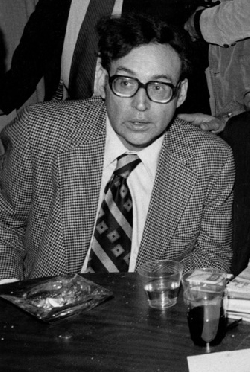
Richard McGarrah Helms (March 30, 1913 – October 22, 2002) served as the Director of Central Intelligence (DCI), June 1966 to February 1973. He began intelligence work with the Office of Strategic Services during World War II. Following the 1947 creation of the Central Intelligence Agency (CIA) he rose in its ranks during the Truman, Eisenhower, and Kennedy administrations. Helms served as DCI under Johnson, then Nixon.
Helms favored information gathering (whether interpersonal or technical, whether covert or overt) and its analysis, and counterintelligence, but remained a skeptic about clandestine operations. He saw it as his duty to keep official secrets. Helms understood his career role as being a person who might express strong opinions over a decision under review, yet in the end working as a team player within the agency, where the President had the final say. While DCI, Helms followed his predecessor McCone in improving the management of the agency. In 1977, as an indirect result of earlier clandestine operations in Chile, he became the only DCI convicted of misleading Congress. His last post in government service was Ambassador to Iran.See relevant text below for the references.
Johnson presidency
In June 1966 Helms was appointed Director of Central Intelligence (DCI). At the White House later that month, he was sworn in during a ceremony arranged by President Lyndon Baines Johnson, which included members of Congress and featured a marine band.Helms (2003) at 250-251 (DCI). The colorful event was a surprise to Helms. In April of the prior year John McCone had resigned as DCI. Johnson then had appointed Admiral William Raborn, well regarded for his work on the submarine-launched Polaris missile, as the new DCI (1965–1966). Johnson immediately chose Helms to serve as Deputy Director of Central Intelligence (DDCI). Raborn and Helms soon journeyed to the LBJ ranch in Texas. Notwithstanding, Raborn did not fit well into the institutional complexities at CIA, with its specialized intellectual culture.Turner (2005) at 103-105, 112-114. Turner faults Roborn, who at the start of his tenure mishandled the CIA’s role regarding Johnson’s political maneuvering following America’s invasion of the Dominican Republic in 1965 (at 103-105).Helms (2003)at 246-149 (under Raborn as DDCI, LBJ ranch, DCI Raborn).
As DCI Helms served under President Johnson during the second half of his administration, then continued in this post until 1973 (through President Nixon’s first term), "two of the most complex and controversial Presidents in the nation’s history".Hathaway and Smith (1993) at 1. At CIA he was the first Director to ‘rise through the ranks’.Ranelaugh (1986) at 448, 731, 736.
Vietnam became the key issue during the Johnson years. Helms reviews the war in his memoirs.Helms (2003) at chapters 25 (Laos and Vietnam), 31 and 32 (Vietnam), 37 (Vietnam and Cambodia). The CIA was fully engaged there in political-military affairs, both to get intelligence information and for field operations. CIA, for example, organized an armed force of minority Hmong in Laos, and in Vietnam of rural counterinsurgency forces and of minority Montagnards in the highlands. Further, CIA became actively involved in South Vietnamese politics, especially after Diem. "One of the CIA’s jobs was to coax a genuine South Vietnamese government into being."Powers (1979) at 204-206 (Hmong or Meo, Montagnard, and other forces); at 209-212 (politics), 210 (quote).Helms (2003), e.g., at 336-339 (Phoenix program forces re rural "pacification"). Helms traveled to Vietnam twice,Powers (1979) at 213: first with DCI McCone in spring 1962, then with the CIA Vietnam specialist George Carver in October 1970. and also flew with President Johnson to Guam.Hathaway and Smith (1993) at 4.
Vietnam: Estimates
In 1966 Helms as the new DCI inherited a CIA "fully engaged in the policy debates surrounding Vietnam, itself with a view on policy but expected to contribute impartially to the debate all the same."Ranelagh (1986) at 450. American intelligence had a relatively long history in Vietnam, dating back to OSS contacts with the communist-led resistance to Japanese occupation forces during World War II.Tucker, editer, Enclyclopedia of the Vietnam War (Oxford Univ. 1998, 2000), "C.I.A." at 66. In 1953 CIA’s first annual National Intelligence Estimate on Vietnam reported that French prospects may "deteriorate very rapidly".Ranelagh (1986) at 430-431. After French withdrawal in 1954, CIA agents including Lt. Col. Edward Lansdale assisted Diem in his reconstitution of government in the south: the Republic of Viet Nam.Colby (1978) at 104, 142-145. Lansdale was an early counterinsurgency advisor.Tucker, ed., Encyclopedia of the Vietnam War (1998, 2000), "Lansdale" at 220.
Continue reading: part 2 of 43 →More in Spies


Also born on March 30
 Carl SolomonMarch 30, 1928 - February 26, 1993Chad Oliver30 March 1928 - 9 August 1993Cyril Radcliffe, 1st Viscount Radcliffe30 March 1899 - 1 April 1977Don HollenbeckMarch 30, 1905 - June 22, 1954