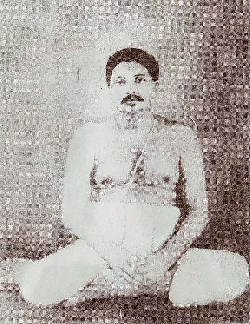
Ramananda (∼1400-1470), also referred to as Saint Ramanand or Swami Ramanand, was a Vaishnava saint. He is considered to be the reviver of the Ramanandi sect. Ramananda for the most part of his life lived in the holy city of Varanasi and was a pioneer of the Bhakti movement, as well as a social reformer in Northern India.
He was known for communicating in vernacular Hindi and accepting disciples of all castes. His 12 disciples are very famous-Anantananda, Bhavananda, Dhanna Bhagat, Kabir, Nabha, Naraharyanda, Pipa, Ravidas (also known as Guru Ravidas), Bhagat Sain, Sukhanada, Ranka and Tulsidas (Not the author of the Ramcharitmanas).
Saint Ramananda is generally considered to have been born around AD 1400; some say that he was born in 1366 CE. Although there is disagreement on the exact date and place of birth, due to the few texts regarding his early life. The birthplace has been suggested to be Triveni Sangam Allahabad, Prayaga. He was born to an upper-caste Brahmin family, and his parents were probably named Sushila and Punyasadan Sharma. He was spiritually inclined right from his childhood. Acharya Raghavanand who is also known as Dakshinayat Rishi (as he lived in Jagannath Puri which is always considered a southern city in Hindu scriptures) included him in the Ramavat sect. Ramananda spent most of his life in Kashi (Banaras / Varanasi), where, as a mark of respect, people built a memorial that stands there to this day.
When Ramananda was a child, he studied the Hindu scriptures and showed great interest in spiritual thoughts. He received his early education in Kasi. A renowned philosopher and the prophet of the new Vaishnava religion, known for his downplaying the role of caste, Ramananda was particularly known for worshipping Lord Rama and his wife Goddess Sita. Ramanuja and Ramananda both believed that the human soul is distinct from the Supreme Spirit and retains its identity and separate consciousness.
Teachings
The institutional centrality of Ramananda has long been reflected in the ‘guru parampara’ that connects every Ramanandi through an unbroken succession of gurus with Ramanand himself and, eventually, Ramchandra.
Ramananda defined his own studies with his dedication and self-surrender to the Supreme Soul, ‘Paramatma’. According to Saint Ramananda, Lord Rama was the Supreme Spirit and the human race was simply one large family, ‘Vasudaiva Kutumbakam’. He was a skilled and impressive preacher, who drew large crowds wherever he travelled, yet most of Ramananda’s poems and sayings were not preserved. The result is the lack of texts that modern scholars and historians can use to unearth the life of Ramananda.
Ramananda was a learned man. Many of the books which are supposed to have been written by him such as Sri Vaishnava, Matanbuj Bhaskar and Sri Ramarachan Padhti are still available. He is also said to have authored a commentary called AnandabhAShya. In Sri Vaishnava, Matanbuj Bhaskar, Vaishnav Ramananda gave his profound philosophy and declared everyone has right to take refuge of Rama, a person can take refuge of Shri Rama in any mood (either Shanta, or Dasya, or Sakhya, or Vatsalya or Kanta Bhava). He further writes relation between Param-Brahman Rama and the individual soul (Jiva) is like that of two friends, or father (Ram) and son (Jiva), or Husband (Ram) and wife (Jiva), or master and servant, etc.
Focus on Rama
Ramananda taught his followers to pay special attention to Rama and his wife Sita. Because of political dangers looming on the horizon, Rama was a natural focus of worship due to his position as the faultless prince. As outlined in the famous Sanskrit epic, the Ramayana, Rama, while an incarnation of the deity, ‘Vishnu’, was a successful warrior capable of defeating the terrible ten-headed demon-king of the Rakshasas, Ravana.
Shabad of Ramananda in Guru Granth Sahib
- Where should I go?
- My home is filled with bliss.
- My consciousness does not go out wandering.
- My mind has become crippled. || 1 || Pause ||