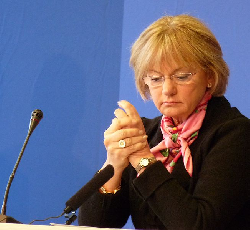
Pia Merete Kjærsgaard ( born February 23, 1947) is a Danish politician. She is a co-founder and former leader of the Danish People’s Party, a nativist, national conservative political party in Denmark. She has become one of the best-known politicians in Denmark during recent years, both for her vocal and unwavering stance against multiculturalism and immigration, and for her parliamentary support for the center-right governments of Anders Fogh Rasmussen and Lars Løkke Rasmussen from 2001 to 2011. Her success has been an inspiration for anti-immigration and anti-Islamic movements throughout Europe.
On August 7, 2012, Kjærsgaard announced her resignation from the leader position of the Danish People’s Party. She appointed Kristian Thulesen Dahl as her successor, and he took office on September 12, 2012, promising to maintain the course laid out by Kjærsgaard.
Political career
Parliament
Kjærsgaard began her political career as the Progress Party’s candidate in the Ryvang nomination district (1979–1981), followed by the Ballerup and Gladsaxe nomination district (1981–1983), the Hvidovre nomination district (1983–1984), and finally, the Middelfart nomination district (1984–1995).
In 1984, while still with the Progress Party, she secured her first seat in the Folketing (Danish parliament), representing the Copenhagen County constituency (10 January 1984 – 8 September 1987). She next represented the Funen County constituency (8 September 1987 – 6 October 1995).
In 1995, as things were growing increasingly chaotic and anarchic in the Progress Party, Kjærsgaard broke away to co-found the Danish People’s Party (DPP). She stood as the DPP candidate in the Glostrup nomination district in 1997, followed by the Hellerup and Gentofte nomination district (1997–2005). As a DPP candidate, she won a seat in the Folketing, representing the Funen County constituency (6 October 1995 – 11 March 1998).
As support for the Progress Party subsequently dwindled away, the DPP grew. By 2001, it had become the third largest party in the Folketing, securing 12% of the vote. In the 2005 election, the DPP’s share grew to 13.2%, with Kjærsgaard receiving 38,347 "personal votes", second to only the Prime Minister, Anders Fogh Rasmussen.
The Danish People’s Party
The Danish People’s Party advocates a primarily nationalist and nativist platform, and is, in that regard, aligned ideologically with other European far right parties. The DPP’s platform also includes toughening the criminal code and supporting social welfare policies that have traditionally been championed by the center-left Social Democrats.
The DPP achieved considerable success in the 2001 elections, becoming the third largest party in the Folketing. As such, the DPP was able to provide key parliamentary support for the center-right, Liberal-Conservativeminority government led by Anders Fogh Rasmussen. In this capacity the DPP was able to push through many of its platform’s policies.
In both the 2005 and the 2007 election the DPP kept its position as third largest in the Folketing and was thus able to maintain its substantial role in policy-setting through both the remainder of Anders Fogh Rasmussen’s Liberal-Conservative government and through that of successor Lars Løkke Rasmussen.
Views, positions, and goals
Kjærsgaard’s most outspoken political goals are to limit immigration to Denmark, that society should take better care of the elderly, and that Denmark should maintain its sovereignty, especially with regards to the European Union. In the euro referendum she campaigned successfully against the adoption of the Euro.
Her view on immigration has often led to her being compared to politicians such as Jean-Marie Le Pen in France and Pim Fortuyn in The Netherlands.
She is also known to be an ardent supporter of Taiwan’s bid to gain admission to the World Health Organization and the United Nations
Early life
Kjærsgaard was born in Copenhagen, to Poul Kjærsgaard, a paint merchant, and Inge Munch Jensen, a housewife. After completing Danish Folkeskole Education in 1963, she attended the Commercial School in Copenhagen (1963–1965). From 1963 to 1967, she worked as a home care assistant for the elderly in Gentofte. From 1978 to 1984, she was employed as an office assistant in connection with insurance and advertising activities. In 1967, Kjærsgaard married Henrik Thorup, an insurance underwriter. Thorup went on to become a chairperson and regional council member in the DPP, and currently works as a government accountant.
Continue reading: part 2 of 2 →

