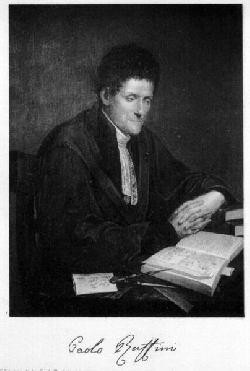
Paolo Ruffini
Italian mathematician
- Life
- September 22, 1765 – May 9, 1822
- Birthday
- September 22
- Field
- Mathematics
Paolo Ruffini
By 1788 he had earned university degrees in philosophy, medicine/surgery, and mathematics. Among his work was an incomplete proof (Abel–Ruffini theoremhttp://www.britannica.com/EBchecked/topic/512337/Paolo-Ruffini) that quintic (and higher-order) equations cannot be solved by radicals (1799Teoria Generale delle Equazioni, in cui si dimostra impossibile la soluzione algebraica delle equazioni generali di grado superiore al quarto.), and Ruffini’s rule which is a quick method for polynomial division. Ruffini also made contributions to group theoryhttp://www.stetson.edu/~efriedma/periodictable/html/Rf.html in addition to probability and quadrature of the circle.
He practiced as both a professor of mathematics (University of Modena) and a doctor — Catholic Encyclopedia article. including scientific workMemoria sul tifo contagioso. on typhus.
Publications
(English definitions) 1799: "Teoria Generale delle Equazioni, in cui si dimostra impossibile la soluzione algebraica delle equazioni generali di grado superiore al quarto" (General Theory of equations, which proves impossible algebraica the solution of the general equations of degree higher than the fourth)
1802: "Riflessioni intorno alla rettificazione ed alla quadratura del circulo" (Reflections on the rectification and the squaring of the circle)
1802: "Della soluzione delle equazioni algebraiche determinate particolari di grado superiore al quarto" (The solution of certain algebraic equations of degree higher than the fourth special)
1804: "Sopra la determinazione delle radici nelle equazioni numeriche di qualunque grado" (Above the determination of the roots in the numerical equations of any degree)
1806: "Della immortalità dell’anima" (The immortality of the soul)
1807: "Algebra elementare" (Elementary algebra)
1820: "Memoria sul tifo contagioso" (Memory is the contagious typhus)
1821: "Riflessioni critiche sopra il saggio filosofico intorno alle probabilità del signor conte Laplace" (Critical reflections on the philosophical essay about the likelihood of Count Laplace)
Group Theory
Ruffini’s 1799 work marked a major development for group theory. Ruffini developed Joseph Louis Lagrange’s work on permutation theory, following 29 years after Lagrange’s "Réflexions sur la théorie algébrique des equations" (1770–1771) which was largely ignored until Ruffini who established strong connections between permutations and the solvability of algebraic equations. Ruffini was the first to controversially assert the unsolvability by radicals of algebraic equations higher than quartics. This angered many members of the community such as Malfatti (1731–1807). Work in this area was later carried on by those such as Gauss and Galois who succeeded in such a proof.The Genesis of the Abstract Group Concept, Hans Wussiong


