Nathuram Godse
Murderer of Mahatma Gandhi
- Life
- 19 May 1910 - 15 November 1949
- Birthday
- May 19
- Length
- 2 parts
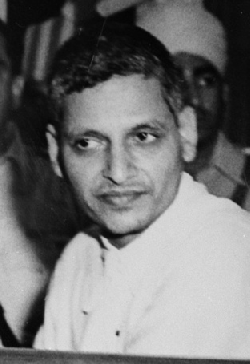
Nathuram Vinayak Godse (19 May 1910 – 15 November 1949) was the sole assassin of Mahatma Gandhi, shooting Gandhi in the chest three times at point blank range on 30 January 1948 in New Delhi. Godse, a Hindu nationalist and ex-member of Rashtriya Swayamsevak Sangh which he left in early 1940s from Pune, Maharashtra who resented what he considered was Gandhi's partiality to India's Muslims, plotted the assassination with Narayan Apte and six others. After a trial that lasted over a year, Godse was sentenced to death on 8 November 1949. Although pleas for commutation were made by India's prime minister Jawaharlal Nehru and by Gandhi's two sons on the grounds that a death sentence would dishonour the legacy of a man opposed to all forms of violence, Godse was hanged a week later.
Early life
Nathuram Vinayakrao Godse was born a Chitpavan Brahmin at nativity mission center Pune District into a Marathi family. His father, Vinayak Vamanrao Godse, was a post office employee and his mother was Lakshmi (née Godavari). At birth, he was named Ramachandra. http://www.nathuram.com/early-life/ Nathuram was given his name because of an unfortunate incident. Before he was born, his parents had three sons and a daughter, with all three boys dying in their infancy. Fearing a curse that targeted male children, young Ramachandra was brought up as a girl for the first few years of his life, including having his nose pierced and being made to wear a nose-ring (nath in Marathi). It was then that he earned the nickname "Nathuram" (literally "Ram with a nose-ring"). After his younger brother was born, they switched to treating him as a boy.
Godse attended the local school at Baramati through the fifth standard, after which he was sent to live with an aunt in Pune so that he could study at an English-language school. During his school days, he highly respected Gandhi.Time (14 February 2000).. Retrieved 3 July 2007 In 1930, Nathuram's father was transferred to the town of Ratnagiri, Maharashtra.
Political career
Godse dropped out of high school and became an activist with Hindu nationalist organizations such as the Hindu Mahasabha, and the Rashtriya Swayamsevak Sangh (RSS), although the RSS has claimed he left during the mid-1930s.The Hindu (18 August 2004). . Retrieved 26 June 2007Zee News(IANS) (30 December 2010). . Retrieved 1 November 2011 They were particularly opposed to the separatist politics of the All India Muslim League. Godse started a Marathi newspaper for Hindu Mahasabha called Agrani, which some years later was renamed Hindu Rashtra.
The Hindu Mahasabha had initially backed Gandhi's campaigns of civil disobedience against the British government.
Godse later rejected Gandhi, believing Gandhi repeatedly sabotaged the interests of Hindus by using the "fasting unto death" tactic on many issues. In Godse's view, Gandhi was giving in to Muslim interests in ways that seemed unfair and anti-national. He blamed Gandhi for the partition of India, which left hundreds of thousands of people dead in the wake of religious unrest.
Godse was against Gandhi's personal teachings of extreme or absolutist nonviolence. He thought that such non-violent ideology would lead to Hindus losing the will to fight against other religions, which he saw as a matter of self-defense, and thereby becoming permanently enslaved. This has been said to be one of the major reasons behind his decision to kill Gandhi.
In art
The actor Horst Buchholz portrayed Nathuram Godse in the 1963 film Nine Hours to Rama.
In the 1982 film Gandhi, the actor Harsh Nayyar portrayed Godse.
The Marathi language play Me Nathuram Godse Boltoy () ("This is Nathuram Godse Speaking"), first staged in 1997, was also produced, but only from Godse's point of view.Rediff on the NeT.
The film Hey Ram, made in 2000, also briefly touches upon events related to the assassination.
Continue reading: part 2 of 2 →