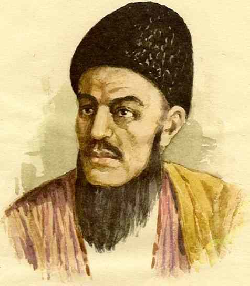
Magtymguly made wide use of the qoshuk form of poetry, which features prominently in Turkmen folk songs and is easily adapted to Turkmen musical forms. The qoshuk form consists of quatrains with lines consisting of eight of eleven syllables, and follows a rhyming scheme of ABCB for the first stanza and CCCB, DDDB, etc. for the following stanzas. The compatibility of Magtymguly’s poems with traditional musical forms allowed them to be easily adopted by bakhshis, traditional singers.Azemoun, Youssef. “Pages From the Life of Makhtumkuli.” Journal of Makhtumkuli Studies 1(1997).
Magtymguly’s first poem, “By night when I was asleep… Revelation,” was composed following an incident when Magtymguly was a young boy. His parents were attending a wedding, but Magtymguly was sleeping, and they left him behind. As he slept, he began to foam at the mouth, and his parents were called back to the house. When his father awoke him, Magtymguly recited his first poem.Azemoun, Youssef. “Gara Ishan.” Additionally, one of Magtymguly’s poems recounts a dream in which Omar Khayyam bestowed upon him the gift of poetic invention.Bakulin, F. “Makhtumkuli.”
His poetry is often highly personal, but also takes up universal themes. His work includes elegies on the deaths of his father and children and the disappearance of his brothers, incitements to Turkmen unity, tirades against unjust mullahs and khans, praises of religious figures (such as the Twelve Imams), and laments at losing his beloved to another.Azemoun, Youssef. “The Significant History.”
On one occasion, Magtymguly’s village was raided , and his possessions, including manuscripts of his poetry, were carried away on a camel. The camel slipped, spilling the manuscript into the Etrek River. Upon seeing this, Magtymguly composed the following lines: “Flood took my manuscript, thus leaving me behind with tears in my eyes.”Azemoun, Youssef. “Gara Ishan.” The poem also contains the lines “Making my dear life lost to all that’s good, / An evil fate wrought awesome sacrilege/ Hurling the books I’d written to the flood, / To leave me bookless with my grief and rage.”Azemoun, Youssef. “Gara Ishan.”
Though Magtymguly apparently recorded much of his poetry, none of the original texts are currently known. A handful of manuscripts’ existence is chronicled by scholars working under the Russian Empire. However, following the Bolshevik Revolution in 1917, Soviet policy regarding anything written in the Arabic script as religious led to the destruction of many of these manuscripts. Many Turkmen who possessed manuscripts buried them while fleeing the Soviet Union to Iran. Azemoun, Youssef, “The Significant History.”


