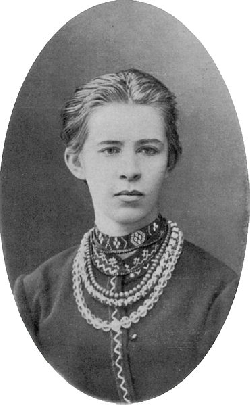
Lesya Ukrainka
Poet and writer
- Life
- February 25, 1871 - August 1, 1913
- Birthday
- February 25
- Length
- 2 parts
Larysa Petrivna Kosach-Kvitka () (February 13 (February 25) 1871 – July 19 (August 1) 1913) better known under her literary pseudonym Lesya UkrainkaNote: "Ukrainka" literally means "Ukrainian woman" in Ukrainian (), was one of Ukraine's best-known poets and writers and the foremost woman writer in Ukrainian literature. She also was a political, civil, and female activist.
Productions of English Translations
- 1994 Yara's Forest Song directed by Virlana Tkacz with Yara Arts Group at
Legacy
kopeck stamp commemorating the 100th anniversary of Lesya Ukrainka's birth.]] Lesya Ukrainka Statue, [[University of Saskatchewan.]] Lesya Ukrainka's burial location and monument at [[Baikove Cemetery in Kiev]]
There are many monuments to Lesya Ukrainka in Ukraine and many other former Soviet Republics. Particularly in Kiev, there is a main monument at the boulevard that bears her name and a smaller monument in the Mariyinsky Park (next to Mariyinsky Palace). There is also a bust in Garadagh raion of Azerbaijan. One of the main Kiev theaters, the Lesya Ukrainka National Academic Theater of Russian Drama is colloquially referred to simply as Lesya Ukrainka Theater.
Under initiatives of local Ukrainian diasporas, there are several memorial societies and monuments to her throughout Canada and the United States, most notably a monument on the campus of the University of Saskatchewan in Saskatoon, Saskatchewan. There is also a bust of Ukrainka in Soyuzivka in New York State.
Each summer since 1975, Ukrainians in Toronto gather at the Lesya Ukrainka monument in High Park to celebrate her life and work.http://www.youtube.com/watch?v=F0ClIh7J6XA
On May 28, 2007, the National Bank of Ukraine released a 200-hryvnia banknote depicting Lesya Ukrainka.
According to image consultant Oleh Pokalchuk, Ukrainka's hairstyle inspired the over-the-head braid of Yulia Tymoshenko.
English translations
- The Babylonian Captivity, (play), from Five Russian Plays, With One From the Ukrainian, Dutton, NY, 1916.
- translated by David Turow
- The Forest Song, (play), in "In a Different Light: A Bilingual Anthology of Ukrainian Literature Translated into English by Virlana Tkacz and Wanda Phipps as Performed by Yara Arts Group", compiled and edited by Olha Luchuk, Sribne Slovo Press, Lviv 2008.
Biography
Ukrainka was born in 1871 in the town of Novohrad-Volynskyi of Ukraine. She was the second child of Ukrainian writer and publisher Olha Drahomanova-Kosach (better known under her literary pseudonym Olena Pchilka). Mykhaylo Petrovych Drahomanov, a well-known Ukrainian scientist, historian, philosopher, folklorist and public figure, was a brother of Drahomanova-Kosach and Lesya's uncle. Lesya had three younger sisters, Olha, Oksana, and Isydora, and a younger brother Mykola. Ukrainka's father was Petro Antonovych Kosach, head of the district assembly of conciliators. Petro came from the northern part of Chernihiv province. After completion his high school in Chernihiv Gymnasium, Kosach went to study mathematics at the University of Petersburg. Two years later, he moved to Kyiv University and graduated in law. Afterwards, in 1868 he married Olha Drahomaniv, Mykhaylo Drahomaniv’s, his friend’s sister. Despite his non-Ukrainian (Belarusian)
background, Kosach was devoted to the advancement of Ukrainian culture and financially supported Ukrainian publishing ventures. Ukrainka was very close to her uncle M. P. Drahomanov (her spiritual mentor and teacher), and her brother Mykhaylo (who would be known under the pseudonym Mykhaylo Obachny) whom she called "Mysholosie."
Lesya had inherited her father’s features, eyes, height, and built. Like her father she was highly principled. Also, they both were delicate in their relationships with people. In addition, they both placed high standards on human dignity in each individual. Despite the fact about many similarities, one respect in which Lesya and her father were different is that her father had a gift for mathematics, but no gift for languages, on the contrary, Lesya had no gift for mathematics, but she knew English, German, French, Italian, Greek, Latin, Polish, Russian, Bulgarian, and her native Ukrainian.
Continue reading: part 2 of 2 →Also born on February 25
 Adelle DavisFebruary 25, 1904 - May 31, 1974Anne Lennard, Countess of Sussex25 February 1661 – 16 May 1721Antony Duff25 February 1920 - 13 August 2000
 Benedetto Croce25 February 1866 - 20 November 1952Bert BellFebruary 25, 1895 – October 11, 1959
 Christian Louis, Duke of Brunswick-Lüneburg25 February 1622 - 15 March 1665