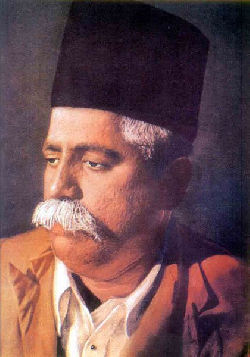
Keshav Baliram Hedgewar
Activists
- Life
- April 1, 1889 - June 21, 1940
- Birthday
- April 1
- Length
- 3 parts
Dr. Keshav Baliram Hedgewar () (April 1, 1889 – June 21, 1940) was the founder and the first Sarsanghachalak of the Rashtriya Swayamsevak Sangh (RSS). Hedgewar found the RSS in Nagpur, Maharashtra in 1925, with the intention of promoting the concept of Hindu nation. He drew upon influences from social and spiritual Hindu reformers such as Swami Vivekananda, Vinayak Damodar Savarkar and Aurobindo to develop the core philosophy of the RSS.
In the National Movement
In Nagpur, Hedgewar became involved with social work and also with the Bal Gangadhar Tilak faction of the Congress Party, through which he developed a close association with Dr. Moonje who later became his mentor of Hindu Nationalism. He also worked with Hindu Mahasabha leaders.
In the 1920 session of Indian National Congress held in Nagpur, Dr.Hedgewar was appointed as the Deputy Chief of volunteers cadre overseeing the whole function. This volunteer organisation was named as Bharat Swayamsewak Mandal and was headed by Dr. Laxman V. Paranjape (Dr. Hedgewar as his Deputy).Dr. Hedgewar Charitra: N. H. Palkar, pp 1-2, 435-436, 73 He and his colleagues unsuccessfully campaigned for the passage of a resolution declaring 'Poorna Swaraj (complete self-rule) as the goal of the Congress.
He participated actively in the Non-cooperation movement in 1920 and undertook a brisk tour in village after village in the Central Provinces for mass awakening. He was promptly jailed and sentenced to one year rigorous imprisonment. During this time, he was also a member of the Hindustan Republican Association
Early life
Dr. Hedgewar was born on April 1, 1889 in Nagpur. He was born on the auspicious day of Gudi Padwa, which is the Hindu New Year's Day. He hailed from a family of Brahmins. His forefathers had migrated from Kandkurti in Bodhan taluka of Nizamabad near the border of Maharashtra and Andhra Pradesh where three rivers of Central India namely the Godavari, Vanjara and Haridra meet. They had migrated to Nagpur in the early nineteenth century to escape Muslim persecution at Kandkurti. His parents were Baliram pant Hedgewar and Revatibai. His father was an orthodox priest and the family lived in dire poverty.
When Keshav was thirteen years old, both his parents succumbed to the epidemic of plague. He had to suffer great hardships on account of being orphaned but never did he seek any help from others as he had a lot of self-respect. Often even when he was hungry, he would not approach his friends for food. Despite travails, his attention to his studies was never affected. His elder brothers Mahadev pant and Sitaram pant ensured that he was provided with good education.
When he was studying in Neel City High School in Nagpur, he was rusticated for singing "Vande Mataram" in violation of the circular issued by the then British government. As a result he had to pursue his high school studies at the Rashtriya Vidyalaya in Yavatmal and later in Pune. After matriculating, he was sent to Kolkata by Dr. B. S. Moonje, (National President of Hindu Mahasabha) in 1910 to pursue his medical studies. After passing the L.M.&S. Examination from the National Medical College in June 1914, he completed one year apprenticeship and returned to Nagpur in 1915 as a doctor.
Death and Legacy
Continuous and strenuous spate of activities took a toll on his health. His health went on deteriorating. Often he suffered from chronic back pain. He started delegating his responsibilities to M.S.Golwalkar, who later succeeded him as Sarsanghachalak (Supreme head) of RSS. In January 1940, he was taken to Rajgir in Bihar for the hot-spring treatment.
He attended the annual Sangh shiksha varg in 1940, where he gave his last message to Swayamsevaks, saying: "Today, I am seeing a mini-Bharat before me. Let there be no occasion in the lives of any of you to say that you were once a Sangh Swayamsevak some years ago."
Dr.Hedgewar died on the morning of June 21, 1940 in Nagpur. His last rites were performed in the locality of Resham Bagh in Nagpur.
Continue reading: part 2 of 3 →
