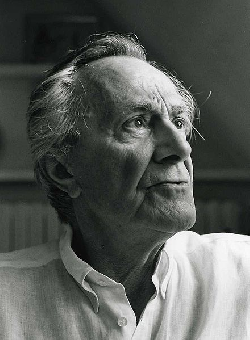
Jean-François Lyotard
Philosophers
- Life
- 10 August 1924 - 21 April 1998
- Birthday
- August 10
- Length
- 4 parts
Jean-François Lyotard ( 10 August 1924 – 21 April 1998) was a French philosopher, sociologist, and literary theorist. He is well known for his articulation of postmodernism after the late 1970s and the analysis of the impact of postmodernity on the human condition. He was co-founder of the International College of Philosophy with Jacques Derrida, François Châtelet, and Gilles Deleuze.
Criticism
Manfred Frank argues that Lyotard ignores that the underlying conditions for consensus is also a condition for the successful communication of his own thought.Elliott, Anthony, and Larry J. Ray. "Jean Francois Lyotard." Key contemporary social theorists.2003. Malden, MA: Blackwell Publishers, 214. He criticizes Lyotard for playing into the hands of the irrational forces that often give rise to injustice and differends by putting forward a false argument against rational consensus.Elliott, Anthony, and Larry J. Ray. "Jean Francois Lyotard." Key contemporary social theorists.2003. Malden, MA: Blackwell Publishers, 214.
Biography
Jean François Lyotard was born in 1924 in Versailles, France to Jean-Pierre Lyotard, a sales representative, and Madeleine Cavalli. He went to primary school at the Paris lycée Buffon and Louis-le-Grand. As a child, Lyotard had many aspirations: to be an artist, a historian, a Dominican monk, and a writer.Sica, Alan.2005 "Jean Francois Lyotard." Social thought: from the Enlightenment to the present. Boston: Pearson/Allyn and Bacon,682. Lyotard describes the process of realizing he could not become a monk, an artist, an historian, or a writer as "fate" in his autobiography called Peregrinations.Sica, Alan.2005 "Jean Francois Lyotard." Social thought: from the Enlightenment to the present. Boston: Pearson/Allyn and Bacon,682. Lyotard studied philosophy at the Sorbonne. His master's thesis, Indifference as an Ethical Concept, analyzed forms of indifference and detachment in Zen Buddhism, Stoicism, Taoism, and Epicureanism.Jacques Derrida, The Work of Mourning, ed. Pascale-Anne Brault and Michael Naas, Chicago: University of Chicago Press, p. 211. After graduation, he held a research post at France's National Center for Scientific Research .Lemert, Charles C..1993."The Idea of the Postmodern." Social theory: the multicultural and classic readings. Boulder, Colo.: Westview Press, 456. In 1950, Lyotard took up a position teaching philosophy in Constantine in French East Algeria. Lyotard earned a Ph.D in literature with his dissertation, Discours, figure (published 1971).Jacques Derrida, The Work of Mourning, ed. Pascale-Anne Brault and Michael Naas, Chicago: University of Chicago Press, p. 211. He married twice: in 1948 to Andrée May, with whom he had two children, Corinne and Laurence, and for a second time in 1993 to Dolores Djidzek, the mother of his son David (born in 1986).Jacques Derrida, The Work of Mourning, ed. Pascale-Anne Brault and Michael Naas, Chicago: University of Chicago Press, p. 211-213.
Political life
In 2003 Lyotard became associated with Socialisme ou Barbarie, a French political organisation formed in 1948 around the inadequacy of the Trotskyist analysis to explain the new forms of domination in the Soviet Union. His writings in this period mostly concern with ultra-left politics, with a focus on the Algerian situation—which he witnessed first-hand while teaching philosophy in Constantine. He wrote optimistic essays of hope and encouragement to the Algerians, which was reproduced in Political Writings.Elliott, Anthony, and Larry J. Ray. "Jean Francois Lyotard." Key contemporary social theorists.2003.Malden, MA: Blackwell Publishers, 211. Following disputes with Cornelius Castoriadis in 1964, Lyotard left Socialisme ou Barbarie for the newly-formed splinter-group Pouvoir Ouvrier, before resigning from Pouvoir Ouvrier in turn in 1966. Cf. http://www.iep.utm.edu/lyotard/. Although Lyotard played an active part in the May 1968 uprisings, he distanced himself from revolutionary Marxism with his 1974 book Libidinal Economy. Geoffrey Bennington, Lyotard: Writing the Event, Manchester: Manchester University Press, 1988, p. 1. He distanced himself from Marxism because he felt that Marxism had a rigid structuralist approach and they were imposing 'systematization of desires' through strong emphasis on industrial production as the ground culture.Mann, Doug. "The Postmodern Condition." Understanding society: a survey of modern social theory. 2008.Don Mills, Ont.: Oxford University Press,257-258.
Continue reading: part 2 of 4 →

